COP26: Sustainable Fashion – how to buy less and buy better
10 November, 2021
/prod01/channel_2/media/university-of-south-wales/site-assets/images/news/2021/11-november/Simone_Dimitrova_sustainable_fashion.jpg)
by Steven Wright, Academic Subject Manager for Fashion, Marketing, Advertising and Photography; and Susan James, Technical Instructor
Designing sustainable fashion
As Dieter Rams says: “Good design is as little design as possible,” the same is true for sustainable design. Solving the problem begins long before any garment exists. The solution to the problem is situated with the designer who must ask themselves:
“Why am I designing this?”
“What is the purpose of this design?”
“How will this design improve the lives of people?”
In this way, the designer can develop a product that is truly functional, beyond aesthetics and focused on creating a better world. For most garments developed in the fashion industry, the overriding rationale is aesthetic. This ignores foundational principles of product design such as ergonomics; we wouldn’t accept a mug that was impossible to hold but, we have no problem purchasing shoes that are impossible to walk in.
Much of fashion’s waste problem stems from a need to endlessly produce products that are useless. It is very possible for garments to be beautiful and meaningful. Central to this is understanding the consumer; knowing the person who is going to wear your garments is key to understanding their needs from the product you design. Most garments are designed based on the aesthetics of the designer, trends and the imagined ideal of a ‘muse’.
This separation of designer and consumer creates a feedback gap, where designers struggle to understand the evolving need of consumers. A perfect example of this is the distinct lack of pockets in womenswear. The need for pockets has become so universal that it has spawned memes and is now a familiar comedic go to. “It has pockets!” shouldn’t be said with surprise and delight.
By understanding the consumer, we create an emotional bond between them and the garments. Loved clothes last a long time, useful clothes even longer. We could have both!
The same can be said for designers not being fully connected to the construction process. Many fashion schools outsource the production of student work (USW is not one of those) which replicates standard industry practice. This process, however, reduces innovation with each person in the chain focusing on their own step, rather than understanding the full system. It is with full system understanding that technical, sustainable innovation can take place.
Each person in the design, production, use and disposal stages of a garment has the duty to be part of a sustainable solution.
Embracing change
Sustainable fashion is not the recycling of clothes you no longer want or need. Accepting this, and applying the true meaning of sustainability to fashion, is the key to changing the fashion industry moving forward.
Understanding that it is not one individual's responsibility or role; we need to stop blaming others because it is easier and enabling us to off-load our guilt, rather than taking responsibility. We need to communicate and push boundaries, continually asking ourselves why, looking for justification in our actions – why do we always do as we have done, it obviously has not been successful.
Understanding that change is necessary, something that is always a constant in our life, but often come with its challenges and uncertainty, can often be daunting. Therefore, change can be hampered by rose-tinted glasses when we reflect, trying to preserve ourselves from the atrocities we have committed for the sake of having something new to wear.
We all want to help, and for some of our customers, the only option is to buy the products that are available. Unfortunately, misdirection within the industry, such as ‘Green Washing’, provide the consumer with a false impression; often blinding them to the true entrepreneurs within the industry who are trying to break the pre-existing ‘cycle of life’ associated with clothing.
Education is one way to help acknowledging these problems we are faced with and embrace change when considering our tomorrow. For example:
- Calling out manufacturers on their ethical policies
- Stop trying to ‘shoe-horn’ in the word sustainable to make a product ‘on trend’ or misdirection with ‘Green Washing’ – real action is necessary
- Understanding and engaging with a circular economy inbuilt into the manufacturing process from concept to end of life
- Communicate, listen, understand, and work with other areas of the industry – do we really know what happens to our garments and the issues around putting product back into the manufacturing process?
- New technologies – Computer Aided Design enabling the virtual creation of product prior to consumer engagement
- Production in relation to orders – this manufacturing model is increasing but still not mainstream. Why is this the case? What can else can be done? We need consideration of other alternatives
- The consumer experience and engaging with change – what could this look like?
- We can all appreciate that this takes time – a most valuable asset – and if we do not do something about it now, in the future there will no be time left.
How our students are tackling the industry’s challenges
Before Yours is a magazine created by Kate Rossini, BA (Hons) Fashion Promotion graduate, which highlights the sustainable potential of pre-loved clothing. The idea behind Before Yours is that when we unlock stories about a garment’s past — whether it is a family heirloom, was worn at a festival, or was handed down by a friend — that garment becomes more meaningful. It is from that place of meaning that clothing continues to be loved, cherished, and shared; keeping it out of landfill and in steady wardrobe rotation. Through styling, photography, graphic design, poetry, interviews, and creative writing, Before Yours tells these stories and emphasises the relationship that wearers have with their pre-loved garments.
Inspired by the recent publication of the book Loved Clothes Last: How the Joy of Rewearing and Repairing Your Clothes Can Be a Revolutionary Act, Fashion Promotion lecturers Emma Jones and Jenn Whitney have developed a workshop dedicated to exploring fashion promotion tactics with pre-loved clothing. First, students are invited to bring in their oldest or most loved garment. Once in the classroom, students swap garments, and undertake an object analysis. This exercise provides some introductory insights — from determining the era in which the garment was made, to identifying the fabrics and processes used in its production. From there, students reclaim their original garment and create individualised hangtags that detail the personal history, meaning, and significance behind it.
Focusing on these details underscores the personal importance of each garment and establishes a connection between the garment and the wearer: taking the contextual history noted in the object analysis to a deeper level. Students then place their garments on the ‘no sale’ rack to emphasise that sentimental value can make clothing invaluable to its owner, and thus, not for sale. The final step in the workshop allows students to style and model their garment in a pop-up photoshoot, breathing new life into the clothes that they already love to wear. The steps and outcomes of this workshop focus on a move away from fast fashion to a more sustainable approach that highlights how loved clothes last.
Jayne Barne (pictured with Caryn Franklin), a recent Fashion Design graduate, created her Ikona collection in response to the fashion industry’s polluting environmental impact. Inspired by her Greek heritage, and her maternal grandparents’ talent for making beautiful garments from whatever they had, Jayne decided to use waste materials that would otherwise end up in landfill – including bicycle inner tubes, which are made from a synthetic rubber that does not biodegrade.
She experimented with knitting, weaving, macrame, crochet and embossing, bonding waste textiles and plastics together using heat, to create an original material. After deconstructing the inner tubes into strips, Jayne began to weave each strip together to produce panels which, along with some black merino wool she had found in a charity shop, were later used to construct the garments she had designed.
Jayne said: “As a new designer, I didn’t want to further contribute to the pollution of the fashion industry, and instead wanted to make a difference and to raise awareness of how damaging unconscious consumerism can be.
“My Ikona collection received a lot of attention and was exhibited at Graduate Fashion Week, as well as being featured right across their campaign on multiple social media platforms. It was shortlisted for the Vivienne Westwood Sustainability Award, as well as the David Band Textile Award. Caryn Franklin OBE was the guest speaker at the Graduate Fashion award ceremony, and personally requested to wear one of my garments from my collection.”
Simone Dimitrova, who also graduated from Fashion Design, is originally from Bulgaria and was inspired by her family heritage to create her first collection, The Shared Memory.
Her aim was to make timeless pieces using deadstock fabrics and materials, using what she had learned about sustainability in fashion during industry internships in her final year. Focusing on crafts and what can be achieved while working from home, Simone used 100% organic yarn to make crocheted socks and mittens, merino wool for the sleeves of the garments and even some old family fabrics from her grandmother’s home to create a bag.
Simone said: “I aspire to design goods that are meant to be worn today and treasured forever, sharing memories. I am committed to continuing to do better and bringing about practices that protect the world we live in.
“To think green, and to think about the future of the planet, is vital for our existence. The environmental impact of fast fashion is huge for our industry, which confronts the future of fashion. For me, the solution for reducing the levels of waste, pollution, and social impacts is to bring better sustainable practices and to give the smaller brands the chance to shine, rather than to keep with the same old ways of producing new collections each week.”
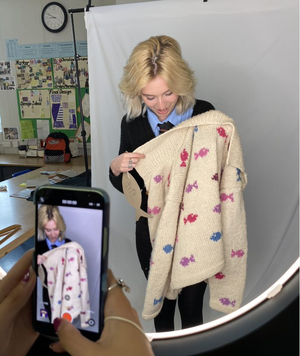

Kate Rossini
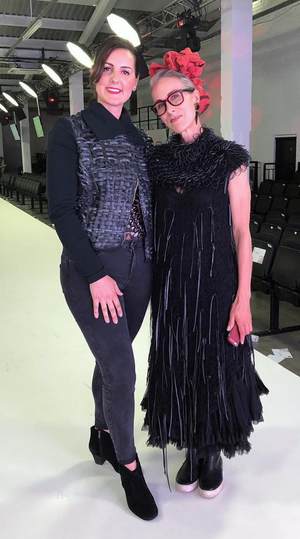
Jayne Barne (pictured with Caryn Franklin)

Simone Dimitrova