Nursing (Child)
Successful completion of this child nursing degree will allow you entry to the Nursing and Midwifery Council (NMC) Register as a qualified children’s nurse and ready to embark on a rewarding career.
Applications for September 2026 are now closed.
How to apply Register for open day Chat to us/filters:format(webp)/prod01/channel_2/media/university-of-south-wales/site-assets/images/03-courses/nursing/bsc-nursing-child.png)
UCAS Code
B702
Start Date
September 2027
Location
Pontypridd
Campus Code
A
UCAS Code
B702
Start Date
September 2026
Location
Pontypridd
Campus Code
A
International students: £17,200*
Course Overview
This three-year child nursing degree combines theory and practice in an innovative way, to focus on the care of children across a wide range of healthcare settings.
Approved by
/prod01/channel_2/media/university-of-south-wales/site-assets/testing/holly-test-images/nmc-logo.gif)
Approved by The Nursing and Midwifery Council
Why study this course?
What you'll study
Theory modules consist of a mix of core and field-specific learning.
Core subjects apply to all fields of nursing whilst field-specific sessions allow you to put theory to practice, helping children in a variety of care settings.
Your introduction to nursing essentials, including key concepts in physical, psychological, social, and spiritual health. Developing essential skills.
Learn to identify, define, and measure health needs across a lifespan. Apply health promotion, protection, and well-being theory to practice.
This module can be studied 100% through the medium of Welsh.
Understand the processes and techniques of person-centred assessment. Develop your clinical skills in delivering fundamental assessments.
Develop your proficiency and confidence in placements by exploring necessary documentation, reflective practice, safe administration of medicines, and nursing skills
Build on your skills and knowledge with theory and specialist-supervised placements as you develop as a student nurse.
What you learn in lectures will be discussed in specialist workshops and tutorials with other nurses to add context to the theory.
Build your abilities in assessment, diagnosis and therapeutic interventions. Learn about collaborating across specialisms and person-centred care.
Explore professional, legal, and ethical concepts and principles relating to healthcare. Become politically aware and build influencing skills.
Develop assertiveness, teamwork skills and professional courage. Understand ethical approaches and decision-making principles like mental capacity.
Deepen understanding of evidence, quality and continuous improvement. Explore research methodologies and evaluation approaches.
Your final year will help you develop into a proficient nurse ready to work independently and as part of a wider healthcare team.
The same blend of theory, practice, and personal support will help you qualify feeling ready for your new career.
Advance your skills in caring for people with complex conditions. Explore pathophysiology and complex care management communication.
Develop leadership skills. Consider policy change impacts on care delivery. Study resource management, shared decision-making and accountability.
Expand your teaching and feedback skills. Practice presentation skills and develop accessible approaches to teaching and learning.
Become ready for registration by understanding the principles of lifelong learning. Consolidate communication, supervising and nursing skills.
We regularly review our courses to keep pace with changing skills and employer needs. If a review leads to significant changes, we’ll contact you to explain what’s changing for the coming year.
Teaching and Assessment
You’ll learn theory, then put it into practice with alternating blocks of classes and placements, with each year lasting at least 42 weeks. You’ll graduate with the skills and confidence to start your career as a specialist caring for children.
You’ll study with students from all fields and other professions, as well as having sessions specific to your field. There’s also the requirement to work with clients and patients from other fields, so you can care for patients with multiple and complex needs. The nursing degree lasts a minimum of 42 weeks. Supervised practice placements are an integral part of the programme. There’s an equal split between theory and practice, which is integrated throughout all our nursing courses.
You’ll be assessed across both theory and practice as you learn alongside students from different nursing fields and professions, as well as in sessions focused on your specialism. You’ll also work with patients from a range of fields, showing your ability to care for people with complex needs.
Over a minimum of 42 weeks, you’ll complete supervised placements where your clinical skills are assessed in real settings. Alongside this, you’ll complete academic work to demonstrate your knowledge. With an equal split between theory and practice, you’ll be assessed on how well you apply learning in both areas.
Supervised placements are an integral part of the child nursing programme. These are in our partner health boards, as well as in the community and independent sector. You will be fully supported on clinical placements by a qualified nurse, who acts as a mentor throughout your placement. When you are working with your mentor in clinical practice, you have to work the shift patterns of the clinical area to which you are allocated. There is also an opportunity to study and practice abroad in a number of countries during your second year. This will enable you to gain an understanding of different health care systems.
Practise in a realistic Clinical Simulation Suite, including a replica flat, ambulance, GP rooms, and hospital wards. Build skills using real equipment and lifelike patient simulators, preparing for everything from basic care to complex clinical scenarios in healthcare settings.
Course Leader
Rachel Watkins
Rachel Watkins specialises in children’s nursing and holds qualifications in Advanced Clinical Practice and Non-Medical Independent Prescribing, with extensive experience in acute and emergency care. She has worked across local health boards, including the University Hospital of Wales Emergency Department building strong professional connections. Rachel is the Wales Lead for CYPNAUK and has co-produced articles with Digital Health Wales, as well as currently contributing to book chapters. Her teaching style is relaxed and supportive, encouraging participation to build confidence and apply learning to real-world clinical practice.
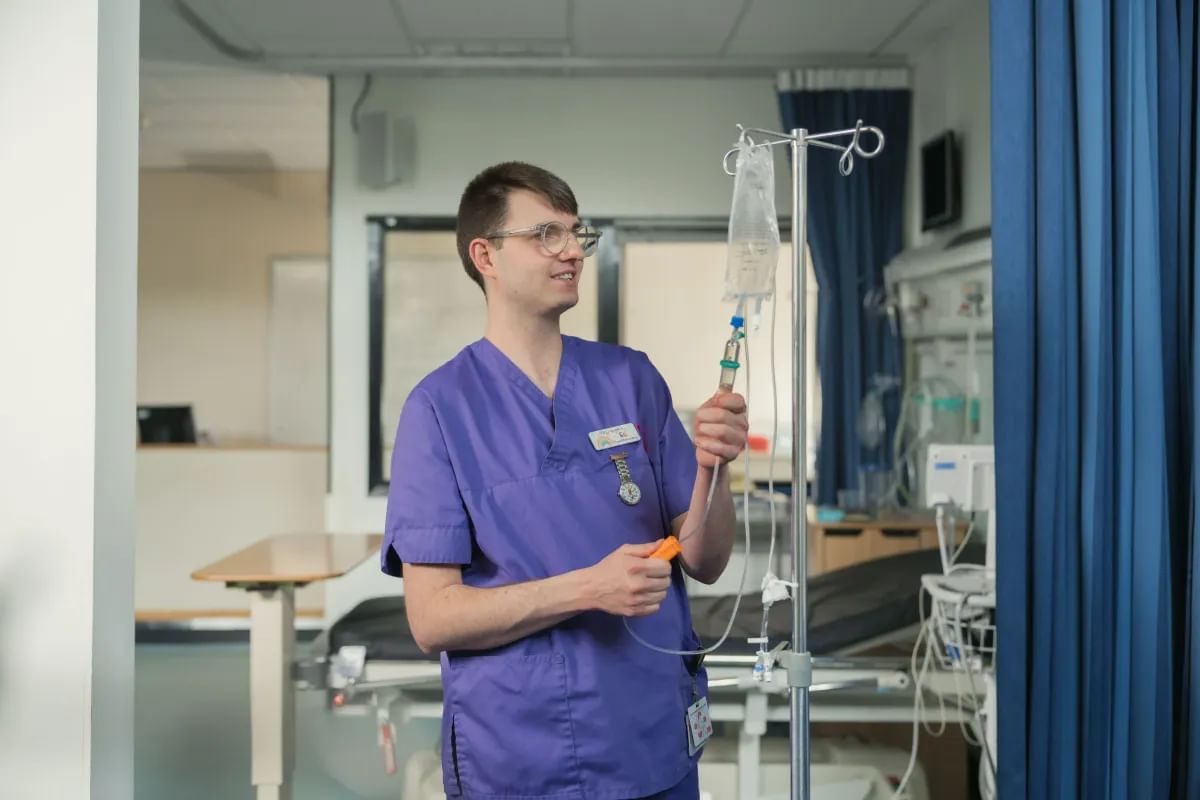
“Each placement has offered a different level of responsibility, helping me apply theory to practice and develop my clinical skills."
Edward Pace, Nursing student
Entry Requirements
We strongly advise applicants to take advantage of the advice available online, from demonstrating you have the relevant qualifications or experience, tips on writing your personal statement to advice on preparing for interview, we have a wealth of support and guidance available to applicants to ensure you are able to demonstrate that you have what it takes and make your application the best it can be. Please read our application advice.
Additional
- All applicants are required to attend an interview. For further support on preparing for interview and what to expect at interview, please read our application advice.
- One satisfactory reference from someone who is able to comment on your attitude and approach to learning in a professional or academic sense.An Enhanced Disclosure and Barring Service (DBS) check on the Child & Adult Workforce and Child & Adult Barring List and subscription to the DBS Update Service is required. (Overseas equivalent required for non-uk applicants).
- A satisfactory medical will be required once an offer has been made. We will contact you closer to your start date with details of how to obtain these.
- The University normally requires a minimum 5 GCSEs including Mathematics/Numeracy and English at Grade C or Grade 4 or above, or their equivalent, but consideration is given to individual circumstances.
- Equivalent qualifications considered are Essential Skills Level Two in Communication and Application of Number, or Functional Skills Level Two in English and Mathematics. (Must have been achieved since 2016)
Typical qualification requirements
A Level:
BBB to exclude General Studies
Welsh BACC:
Grade B and BB at A Level to exclude General Studies
BTEC:
BTEC Extended Diploma Distinction Distinction Merit
Access to HE:
Must complete 60 credits overall with at least 45 at level 3 and 15 at Level 2. Of the 45 credits at level 3, you will need a minimum of 24 Distinctions, 18 Merits and 3 passes.
Closed for International applicants
Unfortunately, this course is not currently open to international applicants, please visit our course pages where you can find an alternative course choice.
International studentsContextual offers
We may make you a lower offer based on a range of factors, including your background (where you live and the school or college that you attended, for example), your experiences and individual circumstances (as a care leaver, for example). This is referred to as a contextual offer, and we receive data from UCAS to support us in making these decisions.
USW prides itself on its student experience and we support our students to achieve their goals and become a successful graduate. This approach helps us to support students who have the potential to succeed and who may have faced barriers that make it more difficult to access university.
Contextual Admissions PolicyFees and Funding
Studying at university is one of the most significant investments you'll ever make. Whilst you’re studying, you’ll have two main financial obligations – tuition fees and living costs. There’s lots of financial help available from the University of South Wales and external funding sources, that may provide loans (which have to be paid back) and grants, scholarships and bursaries (that don't).
*Full-time fees are per year. Part-time fees are per 20 credits. Once enrolled, the fee is anticipated to remain at the same rate throughout the duration of your study on this course except as described below.
Please be aware that we may increase the maximum fee for home students on full-time undergraduate courses only where the Welsh Government increases the permitted level of inflation of fees. Fees for all students (including part-time, postgraduate and international students) may be amended in accordance with our applicable Fees and Debt Management Policy. We will ensure that students are given clear, intelligible, unambiguous and timely information about our courses and costs in good time, ahead of the next academic year.
As a student of USW, you’ll have access to lots of free resources to support your study and learning, such as textbooks, publications, online journals, laptops, and plenty of remote-access resources. Whilst in most cases these resources are more than sufficient in supporting you with completing your course, additional costs, both obligatory and optional, may be required or requested for the likes of travel, memberships, experience days, stationery, printing, or equipment.
DBS and update service*
An enhanced DBS is required. The update service is recommended. Cost: £64.74 annually for enhanced DBS and £16 for the update service.
Clinical placement
50% of the course takes place on placement. During placement, students may incur costs associated with travel. Travel expenses are available for distances greater than that from home to University. Uniforms are provided, however additional attire such as appropriate shoes that comply with NHS Wales Uniform Policy are expected. Cost: Variable.
Laptop or equivalent
You clinical placement requirements will be captured on an electronic document. You academic work will be available via our Blackboard system, and your module assessments are completed and submitted electronically. Cost: Variable.
*Obligatory
per year
Studying at university is one of the most significant investments you'll ever make. Whilst you’re studying, you’ll have two main financial obligations – tuition fees and living costs. There’s lots of financial help available from the University of South Wales and external funding sources, that may provide loans (which have to be paid back) and grants, scholarships and bursaries (that don't).
*Full-time fees are per year. Part-time fees are per 20 credits. Once enrolled, the fee is anticipated to remain at the same rate throughout the duration of your study on this course except as described below.
Please be aware that we may increase the maximum fee for home students on full-time undergraduate courses only where the Welsh Government increases the permitted level of inflation of fees. Fees for all students (including part-time, postgraduate and international students) may be amended in accordance with our applicable Fees and Debt Management Policy. We will ensure that students are given clear, intelligible, unambiguous and timely information about our courses and costs in good time, ahead of the next academic year.
As a student of USW, you’ll have access to lots of free resources to support your study and learning, such as textbooks, publications, online journals, laptops, and plenty of remote-access resources. Whilst in most cases these resources are more than sufficient in supporting you with completing your course, additional costs, both obligatory and optional, may be required or requested for the likes of travel, memberships, experience days, stationery, printing, or equipment.
DBS and update service*
An enhanced DBS is required. The update service is recommended. Cost: £64.74 annually for enhanced DBS and £16 for the update service.
Clinical placement
50% of the course takes place on placement. During placement, students may incur costs associated with travel. Travel expenses are available for distances greater than that from home to University. Uniforms are provided, however additional attire such as appropriate shoes that comply with NHS Wales Uniform Policy are expected. Cost: Variable.
Laptop or equivalent
You clinical placement requirements will be captured on an electronic document. You academic work will be available via our Blackboard system, and your module assessments are completed and submitted electronically. Cost: Variable.
*Obligatory
/filters:format(webp)/prod01/channel_2/media/university-of-south-wales/site-assets/images/03-courses/nursing/nursing-bsc-nursing-flexible-learning-adult-49333.jpg)
/filters:format(webp)/prod01/channel_2/media/university-of-south-wales/site-assets/images/06-locations/61-cardiff/cardiff-study-spaces-library-56702.png)
Nursing interviews
Everything you need to know before attending your Nursing interview.
Read our interview tipsExplore our facilities
/filters:format(webp)/prod01/channel_2/media/university-of-south-wales/site-assets/images/01-campus-and-facilities/16-pontypridd-facilities/162-glyntaff-facilities/campus-facilities-glyntaff-midwifery-ward-49310.jpg)
How to apply
All applications for full-time undergraduate courses or foundation degrees should be made via UCAS. Take the next step: Apply through UCAS
You can apply to us directly for all part-time undergraduate courses, if you’re seeking advanced entry or you’re an international student. To apply directly, please choose the application form below for your preferred start date and mode of study (full-time or part-time).
-
Nursing (Child)
-
Full-time, 3 years
-
September
-
Pontypridd
-
-
Apply direct
Nursing (Child)
-
Full-time, 3 years
-
September
-
Pontypridd
-
If you already have a relevant qualification or experience related to the course you're applying for, you may be eligible to start at a later stage of the course. For example, students from partner colleges can ‘top up’ their qualifications to a degree by joining us in Year Two or Year Three of a course. This process is known as ‘advanced entry’, you can apply directly to the University for 'advanced entry' using the application forms provided above.
Applicants accepted through advanced entry may study a different combination of modules to those advertised, as they will be joining a course already in progress. You will be contacted and advised about these modules once your application has been processed and an offer made.
International applicants can apply to us directly. If the University has an in-country team in your region, your application will be assigned to them for assistance.
/filters:format(webp)/prod01/channel_2/media/university-of-south-wales/site-assets/images/04-profiles/41-undergraduate-student/profile-ug-nursing-edward-pace-57478.jpg)
Related stories and highlights
/filters:format(webp)/prod01/channel_2/media/university-of-south-wales/site-assets/images/news/2025/05-may/Rhianna-Stephens.jpeg) News Article
News Article
/filters:format(webp)/prod01/channel_2/media/university-of-south-wales/site-assets/images/07-student-life/72-students-union/student-life-students-union--52621.jpg)