Psychology with Developmental Disorders
The BSc (Hons) Psychology with Developmental Disorders covers all areas of psychology needed for Graduate Basis for Chartered membership (GBC) with the British Psychological Society.
How to apply Register for open day Chat to us/filters:format(webp)/prod01/channel_2/media/university-of-south-wales/site-assets/images/03-courses/psychology/bsc-psychology-with-developmental-disorders.png)
UCAS Code
9WQ3
Start Date
September 2026
Location
Pontypridd
Campus Code
A
UCAS Points
96
Fees
Home students: £9,790*
International students: £17,200*
UCAS Code
Start Date
September 2026
Location
Pontypridd
Campus Code
A
UCAS Points
96
Fees
Home students: £804*
UCAS Code
9WQ4
Start Date
September 2026
Location
Pontypridd
Campus Code
A
UCAS Points
96
Fees
Home students: £9,790*
International students: £17,200*
UCAS Code
9WQ3
Start Date
September 2027
Location
Pontypridd
Campus Code
A
UCAS Points
96
UCAS Code
Start Date
September 2027
Location
Pontypridd
Campus Code
A
UCAS Points
96
UCAS Code
9WQ4
Start Date
September 2027
Location
Pontypridd
Campus Code
A
UCAS Points
96
Course Overview
We believe that open minds open doors. That’s why our innovative BPS-accredited BSc Psychology with Developmental Disorders degree combines hands-on learning with a rich variety of placement opportunities and real-life projects to give our Psychology graduates the experience they need to kickstart their careers.
This degree will also help you start forming specialist knowledge in developmental disorders and neurodiversity with a psychological underpinning. It’s also ideal for students wanting to apply psychological understanding to help create change in a world designed for neurotypical individuals within settings such as education, the social sector, or the third sector.
Accreditations
/prod01/channel_2/media/university-of-south-wales/site-assets/testing/logo-british-psychological-society.jpg)
The British Psychological Society.
Why study this course?
What you'll study
In Year One, you will study the core disciplines in Psychology (Developmental, Social, Cognitive and Biological).
Learn how we design research and analyse data in Psychology, and be introduced to the neurodiversity movement, with a focus on Autism, Dyslexia, Dyscalculia, Developmental Language Disorder, Developmental Coordination Disorder, and Attention Deficit Hyperactivity Disorder.
This module enables a deep appreciation of key research that has shaped our current understanding of Psychology as a science, introducing the core BPS areas of cognitive, biological, social, and developmental Psychology.
You will be introduced to the process of conducting research in Psychology, including design, data analysis, and presentation of results, learning about both qualitative and quantitative approaches.
This module can be studied 100% through the medium of Welsh
An introduction to the theory and research associated with a range of Developmental Disorders, specifically ADHD, ASC, DCD, Dyscalculia, Dyslexia, and Developmental Coordination Disorder.
You will deepen your understanding of the core disciplines in psychology, learn about advanced research methods, complete a placement and reflect on your professional development.
In addition, you will learn the approaches used in screening and assessment of developmental disorders, with a focus on real-world application, including an immersive simulation activity in the Hydra Suite.
We will look at the screening and assessment process for different Developmental Disorders, considering the collaborative work of different agencies and organisations to support this process for children and adults.
The chance to obtain sector specific work-related experience and/or transferable employability skills linked to theory and research covered in other course modules, reflecting on the ethical and practical issues associated.
We will build on the knowledge from the first year of your course relating to research methodology, statistics, qualitative analysis, and ethics.
You will develop a critical understanding of how behaviour relates to bodily processes and how the brain influences behaviour, contextualising this with reference to individual differences and historical debates.
You will develop a critical understanding of key theory and research in social and developmental Psychology, deepening your critical appraisal of the role that conceptual and historical issues play in current thinking.
You will complete your research dissertation project, bringing together the knowledge and skills developed over your degree.
You’ll consider approaches to intervention and support when working with neurodivergent people, considering both changes to the wider environment, and support for the individual. This will include an immersive simulation activity, through participation in a mock multi-disciplinary meeting.
An original piece of research where you will have the opportunity to collect and analyse data, assess the ethical issues of research, explore research methods, and report your findings.
You will develop a systematic knowledge and critical understanding of a range of topics and issues in Health Psychology, placed in the context of lifespan development.
You will learn to critically reflect on the theoretical and research perspectives that underpin educational and occupational psychology.
We will evaluate theoretical models of psychological disorders and critically assess the efficacy of different therapeutic interventions.
You will develop a systematic critical appreciation of how social psychology can be applied in the real world; including the role that social identity plays in this process.
We will look at the cognitive consequences of brain damage and disease and explore the current methods of investigating the structure and function of brain systems and regions.
We will explore the role that Psychology plays in all aspects of the criminal and civil justice systems and develop a critical appraisal of this.
We will look at real world application, using methods such as problem-based learning, to consider a range of perspectives when working with individuals with Developmental Disorders, building a range of key skills for employability.
We will critically consider the theory and research associated with different approaches to management and support of a range of Developmental Disorders, looking at the ethical and policy frameworks within the field.
We regularly review our courses to keep pace with changing skills and employer needs. If a review leads to significant changes, we’ll contact you to explain what’s changing for the coming year.
Teaching and Assessment
We want you to have the opportunity to learn about psychology in new ways - one of our most exciting features is how varied the learning is on our course.
Our BSc Psychology with Developmental Disorders course provides you with an engaging and immersive learning environment through workshops, projects, group activities, placements, and simulation learning in the Hydra Simulation Suite. We also arrange guest lectures throughout the year delivered by academics from other institutions and practising psychologists from various fields.
Assessments are designed to build your knowledge and skills step by step using a variety of assessment types.
You’ll move from essays to group dissertation projects, with the opportunity to work with our established industry partners.
As a BPS accredited degree, your assessments will include research reports alongside applied real-world challenges, with the opportunity to use our psychology laboratory facilities.
All students are guaranteed a 6-week placement in our on-campus Early Intervention Service, with opportunities to progress to Level 2 and 3 placements.
This provides you with practical experience and to be able to apply your psychological knowledge in practice.
As part of your degree, you will complete the Professional Practice and Employability module, where you understand and apply psychological theory to the workplace and are supported to complete a placement of your choice
We want to help you enhance your skillset to open as may doors as possible for your future career, and you can also find a range of options for this through our Psychology Plus scheme, including volunteering, internships and short courses.
Our purpose-built psychology lab is filled with industry standard equipment that you will use throughout your studies, as well as interview and observation rooms that allow you, as a researcher, to observe human behaviour in a natural manner through a one-way screen. Some of the equipment that you will use includes eye-tracking equipment, Electroencephalography (EEG) machines, and BIOPAC systems.
Our Psychology department includes teaching rooms, the psychology laboratory, staff offices, student kitchen, and spaces for students to socialise and learn together. This is all located together creating a strong student and staff community.
As part of our dedicated Psychology space, you will also be able to book a space for quiet study and access the dedicated social learning space with computers and psychology textbooks.
Course Leader
Sarah-Anne Ashton
Meet Sarah-Anne, Course Leader for the BSc Psychology with Developmental Disorders programme. Her academic expertise centres on neurodiversity, inclusive education, and the development of personal and social identity, with a particular focus on dyslexia. Her wider research interests include digital accessibility, visual attention, cognitive load, and information processing.
Drawing on her experience as a Primary School Teacher across Foundation Phase, mainstream, ALN, special education, and pupil referral settings, Sarah-Anne brings practical insight and real-world perspective into every module. Her inclusive approach to teaching connects psychological theory with lived experience and professional practice across educational, social, and developmental contexts.
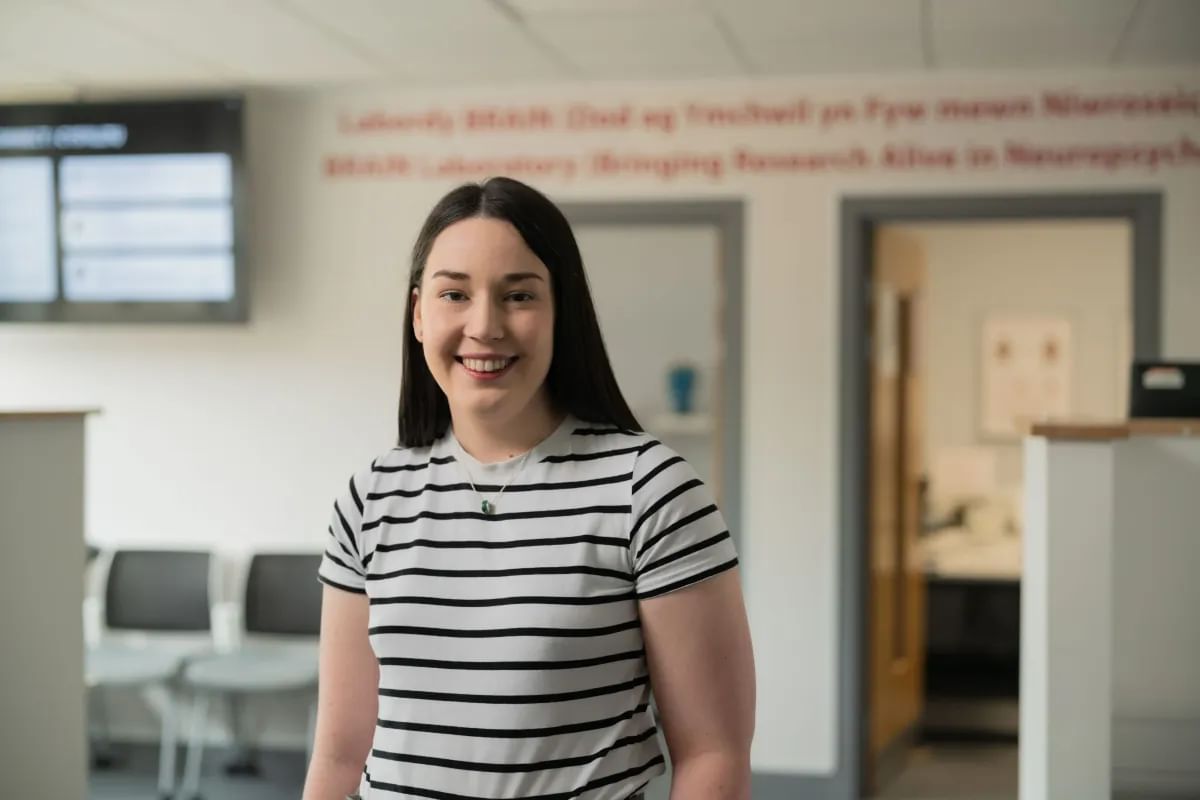
''My favourite part of the course was visiting the Hydra Suite, where I role-played as an educational psychologist exploring developmental disorders—a highlight that brought everything I’d learned to life.''
Emily Campbell, Psychology student
Entry Requirements
Contextual offers
We may make you a lower offer based on a range of factors, including your background (where you live and the school or college that you attended, for example), your experiences and individual circumstances (as a care leaver, for example). This is referred to as a contextual offer, and we receive data from UCAS to support us in making these decisions.
USW prides itself on its student experience and we support our students to achieve their goals and become a successful graduate. This approach helps us to support students who have the potential to succeed and who may have faced barriers that make it more difficult to access university.
How to applyContextual admissions policyAsk us a question96 UCAS points or above
Typical qualification requirements
A Level:
CCC to exclude General Studies
Welsh BACC:
Pass the Advanced Welsh Baccalaureate Diploma with Grade C in the Skills Challenge Certificate and CC at A Level to exclude General Studies
BTEC:
BTEC Extended Diploma Merit Merit Merit
Access to HE:
Pass the Access to HE Diploma with a minimum of 96 UCAS tariff points.
T Level:
Pass (C and above)
Additional requirements include:
The University normally requires a minimum 5 GCSEs including Mathematics/Numeracy and English at Grade C or Grade 4 or above, or their equivalent, but consideration is given to individual circumstances.
International applications welcomed:
We welcome international applications with equivalent qualifications of our entry requirements. For more details related to your country of residence, please view our dedicated country pages.
International studentsPre-Sessional EnglishEnglish language requirements
International applicants will need to have achieved an overall of IELTS 6.0 with a minimum of 5.5 in each component/TOEFL 4 overall and a minimum of 4 in each component or equivalent.
Equivalents can be located on our English Language pages.
If you have previously studied through the medium of English, IELTS might not be required, please visit our country specific page for further details. If your country is not featured, please contact us.
If you do not meet the English entry criteria, please visit our Pre-Sessional course pages.
Fees and Funding
per year
per 20 credits
Studying at university is one of the most significant investments you'll ever make. Whilst you’re studying, you’ll have two main financial obligations – tuition fees and living costs. There’s lots of financial help available from the University of South Wales and external funding sources, that may provide loans (which have to be paid back) and grants, scholarships and bursaries (that don't).
*Full-time fees are per year. Part-time fees are per 20 credits. Once enrolled, the fee is anticipated to remain at the same rate throughout the duration of your study on this course except as described below.
Please be aware that we may increase the maximum fee for home students on full-time undergraduate courses only where the Welsh Government increases the permitted level of inflation of fees. Fees for all students (including part-time, postgraduate and international students) may be amended in accordance with our applicable Fees and Debt Management Policy. We will ensure that students are given clear, intelligible, unambiguous and timely information about our courses and costs in good time, ahead of the next academic year.
As a student of USW, you’ll have access to lots of free resources to support your study and learning, such as textbooks, publications, online journals, laptops, and plenty of remote-access resources. Whilst in most cases these resources are more than sufficient in supporting you with completing your course, additional costs, both obligatory and optional, may be required or requested for the likes of travel, memberships, experience days, stationery, printing, or equipment.
DBS Updating service
Subscription required for each year of the course for a yearly fee of £16. Please note the service has to be joined within 30 days of receipt of your enhanced DBS certificate
Cost: £16
Enhanced DBS
Students will be expected to pay for a DBS or certificate of good behaviour from their home country. The DBS fee includes £49.50 for the enhanced DBS certificate, the Post Office Administration fee and the online administration fee
Cost: £64.74
Placement
Students undertaking placement as part of professional practice modules may incur costs associated with travel to placement.
Cost: Variable
per year
Studying at university is one of the most significant investments you'll ever make. Whilst you’re studying, you’ll have two main financial obligations – tuition fees and living costs. There’s lots of financial help available from the University of South Wales and external funding sources, that may provide loans (which have to be paid back) and grants, scholarships and bursaries (that don't).
*Full-time fees are per year. Part-time fees are per 20 credits. Once enrolled, the fee is anticipated to remain at the same rate throughout the duration of your study on this course except as described below.
Please be aware that we may increase the maximum fee for home students on full-time undergraduate courses only where the Welsh Government increases the permitted level of inflation of fees. Fees for all students (including part-time, postgraduate and international students) may be amended in accordance with our applicable Fees and Debt Management Policy. We will ensure that students are given clear, intelligible, unambiguous and timely information about our courses and costs in good time, ahead of the next academic year.
As a student of USW, you’ll have access to lots of free resources to support your study and learning, such as textbooks, publications, online journals, laptops, and plenty of remote-access resources. Whilst in most cases these resources are more than sufficient in supporting you with completing your course, additional costs, both obligatory and optional, may be required or requested for the likes of travel, memberships, experience days, stationery, printing, or equipment.
DBS Updating service
Subscription required for each year of the course for a yearly fee of £16. Please note the service has to be joined within 30 days of receipt of your enhanced DBS certificate
Cost: £16
Enhanced DBS
Students will be expected to pay for a DBS or certificate of good behaviour from their home country. The DBS fee includes £49.50 for the enhanced DBS certificate, the Post Office Administration fee and the online administration fee
Cost: £64.74
Placement
Students undertaking placement as part of professional practice modules may incur costs associated with travel to placement.
Cost: Variable
/filters:format(webp)/prod01/channel_2/media/university-of-south-wales/site-assets/images/06-locations/61-cardiff/cardiff-study-spaces-library-56702.png)
/filters:format(webp)/prod01/channel_2/media/university-of-south-wales/site-assets/images/01-campus-and-facilities/12-campus-spaces/campus-spaces-cardiff-library-pod.jpg)
Explore our facilities
/filters:format(webp)/prod01/channel_2/media/university-of-south-wales/site-assets/images/01-campus-and-facilities/16-pontypridd-facilities/162-glyntaff-facilities/Psychology-_44484.jpg)
How to apply
Got your results? Apply online or call us today and, if you're eligible, secure our Clearing Package with benefits worth up to £3k to help you start university with more. Take the next step: Apply through Clearing
You can apply to us directly for all part-time undergraduate courses, if you’re seeking advanced entry or you’re an international student. To apply directly, please choose the application form below for your preferred start date and mode of study (full-time or part-time).
-
Apply direct
Psychology with Developmental Disorders
-
Full-time, 3 years
-
September
-
Pontypridd
-
-
Apply direct
Psychology with Developmental Disorders
-
Part-time, 6 years
-
September
-
Pontypridd
-
-
Apply direct
Psychology with Developmental Disorders
-
Sandwich, 4 years
-
September
-
Pontypridd
-
-
Apply direct
Psychology with Developmental Disorders
-
Full-time, 3 years
-
September
-
Pontypridd
-
-
Apply direct
Psychology with Developmental Disorders
-
Part-time, 6 years
-
September
-
Pontypridd
-
-
Apply direct
Psychology with Developmental Disorders
-
Sandwich, 4 years
-
September
-
Pontypridd
-
If you already have a relevant qualification or experience related to the course you're applying for, you may be eligible to start at a later stage of the course. For example, students from partner colleges can ‘top up’ their qualifications to a degree by joining us in Year Two or Year Three of a course. This process is known as ‘advanced entry’, you can apply directly to the University for 'advanced entry' using the application forms provided above.
Applicants accepted through advanced entry may study a different combination of modules to those advertised, as they will be joining a course already in progress. You will be contacted and advised about these modules once your application has been processed and an offer made.
International applicants can apply to us directly. If the University has an in-country team in your region, your application will be assigned to them for assistance.
/filters:format(webp)/prod01/channel_2/media/university-of-south-wales/site-assets/images/04-profiles/41-undergraduate-student/profile-ug-psychology-odette-hornby-44365-400X400.jpg)
/filters:format(webp)/prod01/channel_2/media/university-of-south-wales/site-assets/images/04-profiles/41-undergraduate-student/profile-ug-psychology-antigone-cooper-57490.jpg)
/filters:format(webp)/prod01/channel_2/media/university-of-south-wales/site-assets/images/14-features/profile-ug-psychology-robin.jpg)
/filters:format(webp)/prod01/channel_2/media/university-of-south-wales/site-assets/images/14-features/profile-ug-psychology-jack-erasmus.jpg)
Related stories and highlights
/filters:format(webp)/prod01/channel_2/media/university-of-south-wales/site-assets/images/04-profiles/43-international-students/Psychology-_44461-(1).jpg)
/filters:format(webp)/prod01/channel_2/media/university-of-south-wales/site-assets/images/01-campus-and-facilities/16-pontypridd-facilities/162-glyntaff-facilities/Psychology-_44424.jpg)
/filters:format(webp)/prod01/channel_2/media/university-of-south-wales/site-assets/images/news/2025/03-march/Kayley-Hyman-cropped.png) News Article
News Article
/filters:format(webp)/prod01/channel_2/media/university-of-south-wales/site-assets/images/news/2024/03-march/news-march-klara-price.jpg) News Article
News Article
/filters:format(webp)/prod01/channel_2/media/university-of-south-wales/site-assets/images/news/2026/01-january/GettyImages-1315157617.jpg)
/filters:format(webp)/prod01/channel_2/media/university-of-south-wales/site-assets/images/07-student-life/72-students-union/student-life-students-union--52621.jpg)