Popular and Commercial Music
Develop your performance, songwriting and music industry skills while building your own creative identity.
How to apply Apply through UCAS Book an Open Day Chat to us
UCAS Code
A8C2
Start Date
September 2027
Location
Cardiff
Campus Code
B
UCAS Points
96
International students: £17,600*
Course overview
Build your skills as a performer, songwriter and creative professional while exploring today's music industry.
Through live performance, recording and music production, collaboration and industry-focused projects, you'll refine your craft, build a professional portfolio and gain experience in music creation, promotion and event management.
In collaboration with
Why study this course?
What you'll study
In your first year, you’ll get plugged in to modules that ask you to be innovative with ideas to enhance your creative vision and critical thinking.
You’ll explore songwriting and music history.
Learn about music creation and gain key skills for performing, interpreting and creating original works through collaboration and solo techniques.
This is an immersive module where you’ll work on a live industry brief over 6 weeks. Learn how to plan, prepare and execute an event of your choice.
Explore music within historical and cultural contexts and get a more rounded understanding of the music you love and where it comes from.
Flex your live performance and ensemble playing skills in this practical module. Explore your artistry and develop live performing skills in weekly rehearsals.
Understand the production, recording and mixing techniques used in the production of recorded music. You'll gain skills in the usage of music technology too.
Year two teaches a better understanding of form and content in popular music, songwriting, the business of music, and artist development and imagery.
You’ll also gain studio and musicianship skills.
Look at studio or desktop production from music software applications and apply them to songwriting, composing, arranging and production. You’ll learn to organise musical ideas.
Explore music for Film, TV, animation and games as well as non-visual media such as radio and podcasting. This module is ideal for anyone looking to explore their love for media.
Embrace this practical performance module that invites you to plan and execute live performances and ensemble playing in both solo and collaborative acts.
Discover what it takes to run a music business with realistic concepts of the financial rewards as well as the minefield of contract and intellectual property rights laws.
In your final year, you’ll work on live briefs linked to music industry practices, understand what it takes to be a professional musician and take part in organising and running the Immersed Festival.
This is your chance to explore in depth one of your favourite aspects of the course so far, such as songwriting, performance, production and creating a portfolio.
Manage a digital record label to get expertise in digital distribution. Use critical listening, advanced production techniques and engage with professional music mastering.
This is ideal for budding festival organisers as you’ll get to plan and execute a professional music festival, Immersed Festival, right in the heart of Cardiff.
This is your chance to start planning your career after graduating and develop a portfolio that will help you stand out from the crowd; in any industry you want.
We regularly review our courses to keep pace with changing skills and employer needs. If a review leads to significant changes, we’ll contact you to explain what’s changing for the coming year.
Teaching and assessment
You'll learn through rehearsals, performances, studio workshops, tutorials, seminars and lectures. Throughout the course, you'll develop your practical musicianship while exploring songwriting, recording, music business and live events. Teaching combines creative practice with industry knowledge, helping you build confidence as both a musician and creative professional. Assessment is largely practical, with performances, portfolios, presentations and coursework reflecting professional music practice.
You'll learn by performing, writing, recording and collaborating. Working alongside musicians, producers and industry professionals, you'll develop your musical identity through practical projects, live performances and studio work. As you progress, you'll explore music production, event management and music business while building a portfolio that reflects your creative interests.
Assessment reflects contemporary music practice. You'll complete live performances, recordings, portfolios, presentations and creative projects that demonstrate your musical, technical and professional development. This practical approach allows you to build a portfolio of work while developing the skills needed to work across today's music industry.
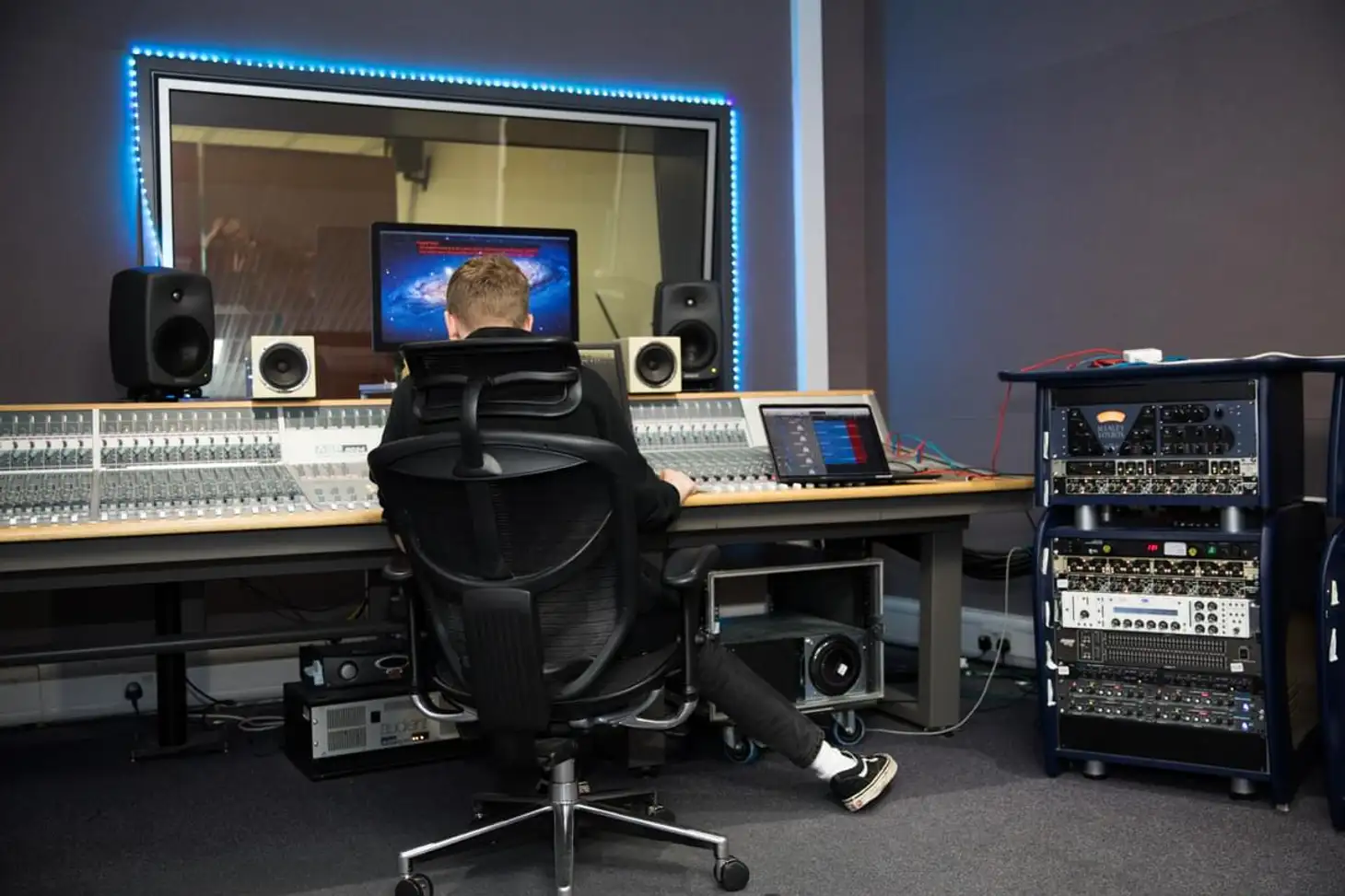
Positioned in the heart of Cardiff, you’ll have direct access to the latest in technology for recording, producing and creating music on our creative campus. From technical demonstrations in our learning labs to exploring software such as Logic Pro, Pro Tools, Ableton Live and Reason, you’ll have access to the best in industry technology for your creative endeavours. You’ll also have access to our on campus recording studios and rehearsal spaces and get connected to our Student Union Bar, where you can get creative and organise your own gigs and events and join the Live Music Society.
You will have the chance to build real-world experience through placements that match your interests, whether that's running live events or recording podcasts on campus. You will also hear directly from industry professionals, including producers, songwriters and touring musicians.
Course Leader

Alun Tomos is Course Leader for BA (Hons) Popular and Commercial Music. With more than 20 years' experience in higher education, he specialises in music performance, live events, and music theory.
Before moving into academia, Alun built a successful career as a freelance musician, performing with signed original bands, function bands, and television house bands, while also working as a session musician in professional recording studios.
As Course Leader for the past 10 years, Alun has helped shape the programme to reflect the needs of today’s music industry. His strong links with recording studios, music venues, and industry partners create valuable opportunities for students to gain real-world experience and industry insight.
Entry requirements
Additional requirements include:
The University normally requires a minimum 5 GCSEs including Mathematics/Numeracy and English at Grade C or Grade 4 or above, or their equivalent, but consideration is given to individual circumstances.
Selection for this course is based on a suitable application. If you do not meet the entry criteria you may also be required to attend an interview to help us assess your suitability for the course.
Contextual offers
We may make you a lower offer based on a range of factors, including your background (where you live and the school or college that you attended, for example), your experiences and individual circumstances (as a care leaver, for example). This is referred to as a contextual offer, and we receive data from UCAS to support us in making these decisions.
USW prides itself on its student experience and we support our students to achieve their goals and become a successful graduate. This approach helps us to support students who have the potential to succeed and who may have faced barriers that make it more difficult to access university.
How to applyContextual admissions policyAsk us a question96 UCAS points or above
Typical qualification requirements
A Level:
CCC to include a relevant subject
Welsh BACC:
Pass the Advanced Welsh Baccalaureate Diploma with C in the Skills Challenge Certificate and CC at A Level with a relevant subject
BTEC:
Merit Merit Merit in a relevant subject
Access to HE:
Pass the Access to HE Diploma with a minimum of 96 UCAS tariff points.
T Level:
Pass (C and above)
International applications welcomed:
We welcome international applications with equivalent qualifications of our entry requirements. For more details related to your country of residence, please view our dedicated country pages.
International studentsPre-Sessional EnglishEnglish language requirements
International applicants will need to have achieved an overall of IELTS 6.0 with a minimum of 5.5 in each component/TOEFL 4 overall and a minimum of 4 in each component or equivalent.
Equivalents can be located on our English Language pages.
If you have previously studied through the medium of English, IELTS might not be required, please visit our country specific page for further details. If your country is not featured, please contact us.
If you do not meet the English entry criteria, please visit our Pre-Sessional course pages.
Fees and Funding
Studying at university is one of the most significant investments you'll ever make. Whilst you’re studying, you’ll have two main financial obligations – tuition fees and living costs. There’s lots of financial help available from the University of South Wales and external funding sources, that may provide loans (which have to be paid back) and grants, scholarships and bursaries (that don't).
*Full-time fees are per year. Part-time fees are per 20 credits. Once enrolled, the fee is anticipated to remain at the same rate throughout the duration of your study on this course except as described below.
Please be aware that we may increase the maximum fee for home students on full-time undergraduate courses only where the Welsh Government increases the permitted level of inflation of fees. Fees for all students (including part-time, postgraduate and international students) may be amended in accordance with our applicable Fees and Debt Management Policy. We will ensure that students are given clear, intelligible, unambiguous and timely information about our courses and costs in good time, ahead of the next academic year.
As a student of USW, you’ll have access to lots of free resources to support your study and learning, such as textbooks, publications, online journals, laptops, and plenty of remote-access resources. Whilst in most cases these resources are more than sufficient in supporting you with completing your course, additional costs, both obligatory and optional, may be required or requested for the likes of travel, memberships, experience days, stationery, printing, or equipment.
Equipment
We suggest students invest in a laptop and smartphone. Laptops can be loaned temporarily from the University if you do not have your own.
Cost: £500-£1,000
Field Trips
Where possible, International Field Trips will be offered to students as an extra-curricular opportunity.
Cost: £500
Travel
Students may be expected to travel to Masterclass/ conferences/ events at their own cost. All academic years.
Cost: £100
per year
Studying at university is one of the most significant investments you'll ever make. Whilst you’re studying, you’ll have two main financial obligations – tuition fees and living costs. There’s lots of financial help available from the University of South Wales and external funding sources, that may provide loans (which have to be paid back) and grants, scholarships and bursaries (that don't).
*Full-time fees are per year. Part-time fees are per 20 credits. Once enrolled, the fee is anticipated to remain at the same rate throughout the duration of your study on this course except as described below.
Please be aware that we may increase the maximum fee for home students on full-time undergraduate courses only where the Welsh Government increases the permitted level of inflation of fees. Fees for all students (including part-time, postgraduate and international students) may be amended in accordance with our applicable Fees and Debt Management Policy. We will ensure that students are given clear, intelligible, unambiguous and timely information about our courses and costs in good time, ahead of the next academic year.
As a student of USW, you’ll have access to lots of free resources to support your study and learning, such as textbooks, publications, online journals, laptops, and plenty of remote-access resources. Whilst in most cases these resources are more than sufficient in supporting you with completing your course, additional costs, both obligatory and optional, may be required or requested for the likes of travel, memberships, experience days, stationery, printing, or equipment.
Equipment
We suggest students invest in a laptop and smartphone. Laptops can be loaned temporarily from the University if you do not have your own.
Cost: £500-£1,000
Field Trips
Where possible, International Field Trips will be offered to students as an extra-curricular opportunity.
Cost: £500
Travel
Students may be expected to travel to Masterclass/ conferences/ events at their own cost. All academic years.
Cost: £100



Explore our facilities
Media Loans
Access industry-standard cameras, lighting, sound and recording gear, supported by free Media Loans and experienced technicians. We have everything you need to help you experiment, refine and bring your work to life with confidence.
How to apply
All applications for full-time undergraduate courses or foundation degrees should be made via UCAS. Take the next step: Apply through UCAS
You can apply to us directly for all part-time undergraduate courses, if you’re seeking advanced entry or you’re an international student. To apply directly, please choose the application form below for your preferred start date and mode of study (full-time or part-time).
-
Apply direct
Popular and Commercial Music
-
Full-time, 3 years
-
September
-
Cardiff
-
If you already have a relevant qualification or experience related to the course you're applying for, you may be eligible to start at a later stage of the course. For example, students from partner colleges can ‘top up’ their qualifications to a degree by joining us in Year Two or Year Three of a course. This process is known as ‘advanced entry’, you can apply directly to the University for 'advanced entry' using the application forms provided above.
Applicants accepted through advanced entry may study a different combination of modules to those advertised, as they will be joining a course already in progress. You will be contacted and advised about these modules once your application has been processed and an offer made.
International applicants can apply to us directly. If the University has an in-country team in your region, your application will be assigned to them for assistance.


Related stories and highlights




 Success Story