Applied Cyber Security
Kickstart your career with expert cyber security education working on real-world cyber security projects while gaining hugely valuable skills and experience, with the added opportunity to undertake specialist certification.
How to apply Apply through UCAS Book an Open Day Chat to us
UCAS Code
7B9P
Start Date
September 2027
Location
Newport
Campus Code
C
UCAS Points
104
International students: £17,600*
Course Overview
With increasing disruption to our critical systems and personal data, we need highly skilled cyber security graduates now more than ever.
This course is designed for those with a keen interest in cyber security, penetration testing, digital crime investigation, cyber governance, risk and compliance, and incident response.
Accreditations
We’re accredited by the BCS, The Chartered Institute for IT
Why study this course?
What you'll study
Learn the fundamentals of the latest cyber security tools, systems, practices and legislation.
Engage with industry partners in workshops and begin to apply your knowledge and skills to real-world problems.
Develop knowledge of legal, social, ethical and professional aspects of computing. Enhance employability skills and critical academic skills around self-reflection and research.
Part of this module can be studied through the medium of Welsh
Become familiar with different aspects of cybersecurity and the tools and practices used within the industry, within the context of legal, social, ethical and professional issues.
Get to grips with the fundamental architecture and computer systems that underpin the practical aspects of cyber security and digital forensics.
Practice the design, installation and configuration of a network, including networking protocols and services, in both existing and emerging network technologies and standards.
Learn the fundamentals of procedural programming and understand the factors associated with application development. Also, customise and build simple applications.
Develop your knowledge of the key underlying principles of IT Governance and Information Security.
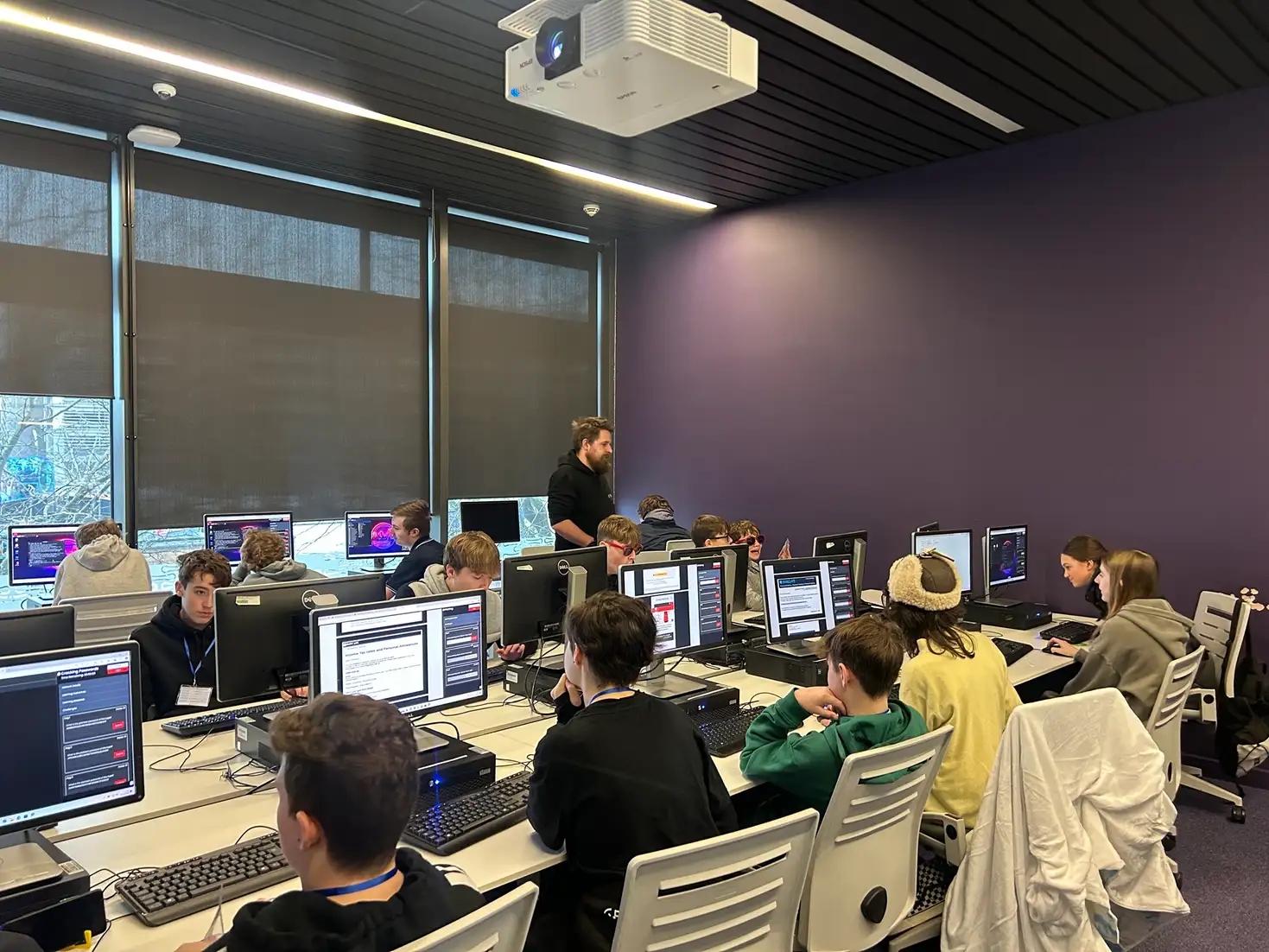
Undertake live briefs in dedicated labs, including our state-of-the-art Secure Operations Centre.
As you deepen your knowledge of more specialised areas of cyber security and develop evaluative and strategic management skills, you’ll start to consider the roles you want to pursue.
As you learn how to develop secure software, you’ll understand security vulnerabilities in programming practices of web-based applications and defend and account for possible exploitations.
As a digital detective, you’ll evaluate, investigate, and create the processes to assist in post-incident analysis.
Develop your theoretical and practical knowledge of computer security methods and practice. Increase your understanding of cybersecurity threats and their prevention, detection, and mitigation.
Understand the tools, techniques, frameworks and legislation of cyber governance and compliance. Evaluate risk management, governance and compliance strategies to manage security infrastructure.
Explore the role of research and evaluation within cyber security and gain a grounding in formal research methods in preparation for your final year research project.
Part of this module can be studied through the medium of Welsh
Study emerging systems in a range of non-standard domains, and associated threats. Learn about microcontrollers and embedded systems architecture, and data collection, storage and transfer protocols.
Specialise in either System Security, where you’ll study the EC Council certification in ethical hacking and penetration testing, or Digital Forensics, where you’ll prepare for court cross-examination and expert witness reports with training and certification from Bond Solon.
Equip yourself with the theory and detailed technical knowledge of red-team and blue-team penetration testing, and master the advanced tools and techniques involved.
Research, design, develop and evaluate a solution to a critical problem pertinent to your specialised programme of study.
Part of this module can be studied through the medium of Welsh
Acquire technical knowledge of the concepts associated with cyber security monitoring, and incident detection, analysis, and recovery.
Consolidate your employability, professional practices, and graduate attributes in line with the 2030 strategy. Show critical awareness of workplace conduct, equality and diversity, and legislation.
Part of this module can be studied through the medium of Welsh
We regularly review our courses to keep pace with changing skills and employer needs. If a review leads to significant changes, we’ll contact you to explain what’s changing for the coming year.
Teaching and Assessment
This is a practical, industry-focused course designed to develop the skills employers are looking for in today’s cyber security professionals. You’ll learn through a combination of lectures, workshops, specialist lab sessions and independent study, applying your knowledge to real-world challenges from the start of your degree. Our focus is on preparing you for a successful career in cyber security, giving you hands-on experience with industry-standard tools and technologies in dedicated facilities. Through live briefs, practical projects and collaboration with industry partners, you’ll graduate with the confidence and experience needed to tackle modern cyber security threats.
You’ll learn by doing, through real-world activities that help you understand how learning works at university. You’ll be encouraged to ask questions, explore new ideas and work with others, as well as independently. Teaching builds confidence, critical thinking and reflection, supported by digital tools. Regular feedback helps you track progress, plan next steps and build resilience and a strong sense of belonging as you prepare for higher-level study.
You’ll be assessed in different ways, including short tasks, coursework, presentations, and group work. Early assessments are designed to support your learning and help you understand what is expected at university. Most assessments are coursework-based and help you develop key skills such as research, academic writing, teamwork, and communication. You’ll also reflect on your progress and use university systems and digital tools. Clear, timely feedback will help you understand how to improve and support your next steps.
The University has excellent relationships with industry, with students undertaking placements with the Financial Services Authority (FSA), Home Office Scientific Development Research Branch (London), GCHQ, Qinetiq, Cy4or, financial services, international banks, the Office for National Statistics, digital forensics companies and various government departments. We also have strong links with security agencies, incident response organisations handling cyber-attacks and local police forces.
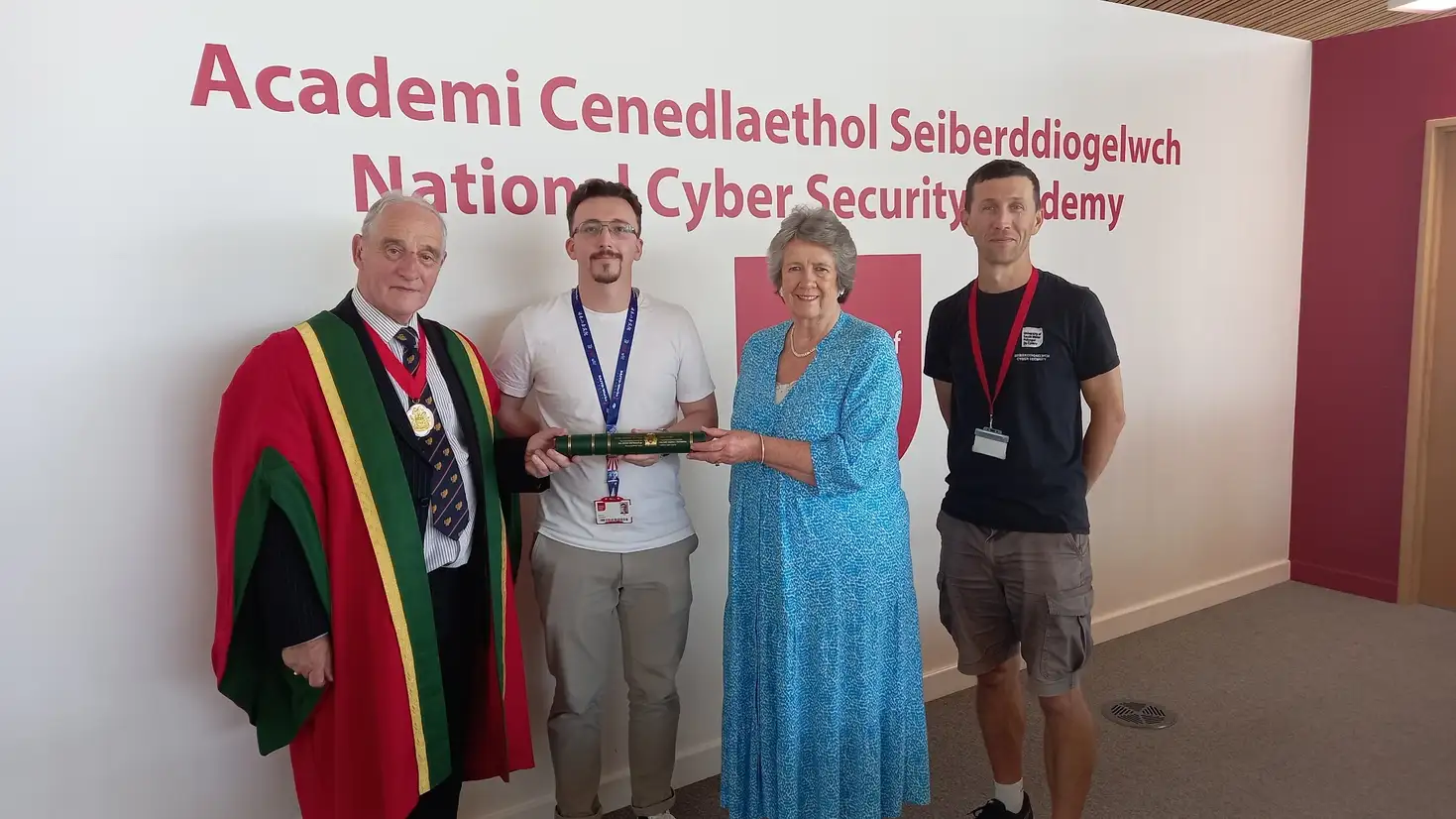
Most of your studies take place at the Newport campus, home of the National Cyber Security Academy in the heart of Wales’s vibrant tech capital. You’re perfectly situated close to major industry players, such as Airbus. With two entire floors dedicated to cyber security, this hive of activity is the perfect place to develop your digital skills. Our Secure Operations Centre (SOC) reflects current industry centres and contains all the high-spec infrastructure and technology you’ll need to fight cyber crime. Our Digital Investigation Lab mirrors those used by law enforcement and corporate analysts during investigations.
Course Leader
Dr Richard Ward
Dr Richard Ward is the course leader for the BSc Applied Cyber Security course at our Newport City campus. Richard's academic interests include applying cyber security to field such as cryptography and SCAs. Richard enjoys sharing his enthusiasm for cyber whether lecturing on one of our award winning cyber courses, supervising his PhD students or at outreach events.
Feel free to email Richard to find out more about the course.

"Attending industry lectures has allowed me to form invaluable professional connections."
Ross Wills, Applied Cyber Security student
Entry Requirements
Additional
The University normally requires a minimum 5 GCSEs including Mathematics/Numeracy and English at Grade C or Grade 4 or above, or their equivalent, but consideration is given to individual circumstances.
Contextual offers
We may make you a lower offer based on a range of factors, including your background (where you live and the school or college that you attended, for example), your experiences and individual circumstances (as a care leaver, for example). This is referred to as a contextual offer, and we receive data from UCAS to support us in making these decisions.
USW prides itself on its student experience and we support our students to achieve their goals and become a successful graduate. This approach helps us to support students who have the potential to succeed and who may have faced barriers that make it more difficult to access university.
How to applyContextual admissions policyAsk us a question104 UCAS points or above
Typical qualification requirements
A Level:
BCC
Welsh BACC:
Advanced Skills Baccalaureate Wales Grade C/B and BC - CC at A Level
BTEC:
BTEC Extended Diploma Distinction Merit Merit
Access to HE:
Pass the Access to HE Diploma and obtain a minimum of 104 UCAS tariff points
T Level
Pass (C and above)
If you don’t reach the entry requirements at Year 1, this course also offers a Foundation Year alternative.
International applications welcomed:
We welcome international applications with equivalent qualifications of our entry requirements. For more details related to your country of residence, please view our dedicated country pages.
International studentsPre-Sessional EnglishEnglish language requirements
International applicants will need to have achieved an overall of IELTS 6.0 with a minimum of 5.5 in each component/TOEFL 4 overall and a minimum of 4 in each component or equivalent.
Equivalents can be located on our English Language pages.
If you have previously studied through the medium of English, IELTS might not be required, please visit our country specific page for further details. If your country is not featured, please contact us.
If you do not meet the English entry criteria, please visit our Pre-Sessional course pages.



Explore our facilities

How to apply
All applications for full-time undergraduate courses or foundation degrees should be made via UCAS. Take the next step: Apply through UCAS
You can apply to us directly for all part-time undergraduate courses, if you’re seeking advanced entry or you’re an international student. To apply directly, please choose the application form below for your preferred start date and mode of study (full-time or part-time).
-
Apply direct
Applied Cyber Security
-
Full-time, 3 years
-
September
-
Newport
-
If you already have a relevant qualification or experience related to the course you're applying for, you may be eligible to start at a later stage of the course. For example, students from partner colleges can ‘top up’ their qualifications to a degree by joining us in Year Two or Year Three of a course. This process is known as ‘advanced entry’, you can apply directly to the University for 'advanced entry' using the application forms provided above.
Applicants accepted through advanced entry may study a different combination of modules to those advertised, as they will be joining a course already in progress. You will be contacted and advised about these modules once your application has been processed and an offer made.
International applicants can apply to us directly. If the University has an in-country team in your region, your application will be assigned to them for assistance.


Related stories and highlights
 News Article
 News Article