Computing
You’ll develop essential skills and gain a deep understanding of the technologies you’ll need for a long and varied career in the fast-moving IT industry.
How to apply Apply through UCAS Book an Open Day Chat to us
UCAS Code
G401
Start Date
September 2027
Location
Pontypridd
Campus Code
A
UCAS Points
104
International students: £17,600*
UCAS Code
I103
Start Date
September 2027
Location
Pontypridd
Campus Code
A
UCAS Points
104
Course Overview
Computing skills are desirable and transferrable; create a bright future career with this practical course.
If you’ve enjoyed studying a computer-based subject at A-Level or BTEC, or even if you’ve just had fun playing around with your own computer or using technology for solving problems, this is the course for you. The course is both hands-on and provides theoretical learning that is tied closely to practice.
Computing courses at USW are ranked top in Wales for teaching quality and academic support in the National Student Survey 2025.
Accreditations
We’re accredited by the BCS, The Chartered Institute for IT.
Why study this course?
What you'll study
In your first year, you’ll learn web design, how to access and store data, and how to customise and build simple applications.
You’ll gain first-hand experience of how theories are applied to real-world problems and how to solve them.
Learn web design and development using HTML and CSS, understanding what makes a good website and how to create one from scratch.
Gain first-hand experience of how computers are connected in a network, applying your skills to real-world problems and scenarios.
Delve into the legal, social, ethical, and professional issues that prepare you for a career in computing and IT.
*Part of this module can be studied through the medium of Welsh
Get to grips with how information systems allow us to store and access data, as you’re introduced to the methods used to securely create databases.
Customise and build simple applications after being introduced to the fundamentals of procedural programming using the C# language.
Learn to apply and interpret various problem-solving techniques that will help you throughout the course.
Build on your skills by implementing systems and databases, and gain practical experience in installing, configuring, and managing an operating system.
Take advantage of a work placement in the computing industry to gain relevant experience and boost your CV.
Explore different best-practice approaches to organising a project from the planning stage to completion.
Building on your web skills from year one, gain experience in finding and using appropriate web and scripting tools.
Implement a working Content Management System (CMS) and learn how to make your content accessible using Search Engine Optimisation (SEO) practices.
Take your database skills further as you use appropriate techniques to design and implement relational and spatial databases.
The Professional Practice and Employability module gives you real-world work experience which we help provide. You’ll also work as part of a team to create a piece of software.
Gain practical experience installing, configuring, and managing an operating system. Then learn how to manage a network of connected computers.
Choose your favourite topic and bring it to life.
Get hands-on with the Internet of Things and work with Geographical Information Systems, operating systems, and network technologies.
Time to get creative with your favourite topic from the course. Explore the subject in depth and create something special.
Design and create solutions to practical problems in homes, workplaces, and public spaces by getting your hands on Internet of Things (IoT) technologies.
You’ve already learned about databases, now you can become an expert. Take things further as you design solutions to complex and realistic problems.
Building on previous modules, you’ll design and create modern web applications that will be interactive, and accessible using mobile devices.
You’ll use a variety of Geographical Information Systems (GIS) techniques to see how maps and location data can be used to solve real-world problems.
Get ready to apply your skills as a professional in the workplace as this module works with you on applying yourself in the computing industry.
We regularly review our courses to keep pace with changing skills and employer needs. If a review leads to significant changes, we’ll contact you to explain what’s changing for the coming year.
Teaching and Assessment
This hands-on course gives you the chance to build practical IT skills by learning through real projects and activities. You’ll spend lots of time in our computer labs using industry-standard hardware and software to create websites, develop software, design databases and solve real-world problems. Most of your assessment will be coursework, so you can show what you can do through practical tasks rather than exams. You’ll learn from experienced and supportive staff who will know you by name and help you build the skills and confidence you need for your future career.
We’ve worked with employers and students to create an accredited course that reflects current industry practice and delivered in a hands-on style. You’ll spend a lot of time in our computer labs, learning by doing and using our cutting-edge equipment to be creative and innovative.
You’ll complete a variety of coursework tasks, individually and as part of a group, that focus on your practical skills. You might make a website, or a piece of software, create a database, or design a solution for a real-world problem using IT.
You can choose to study full-time across three years, or as a sandwich degree, where you can spend an entire year working in the industry in the UK or abroad. There is also the option to study the course part-time through the Network75 scheme, where you will work with one of our partner employers, earning money whilst you study. It usually takes five years to complete your degree this way.
In your second year, you’ll complete a 70-hour work placement as part of your studies, which will help you further understand the world of work in IT through first-hand experience.
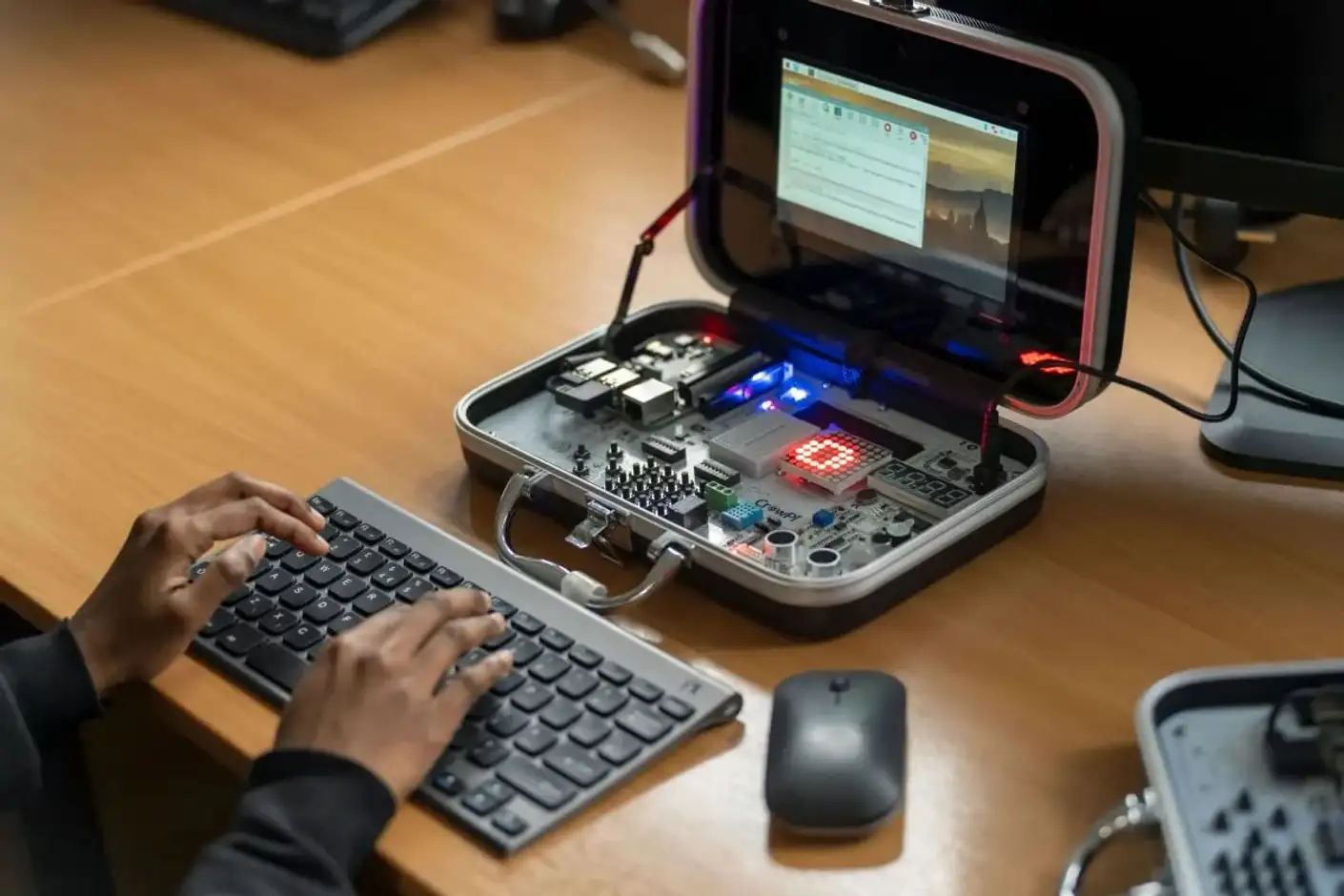
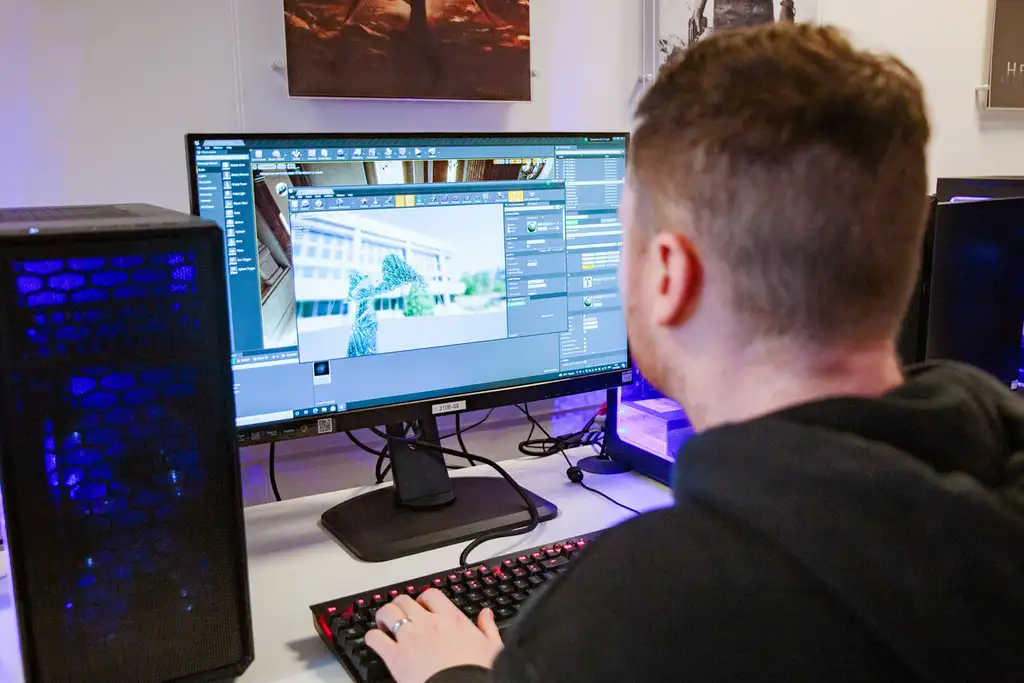
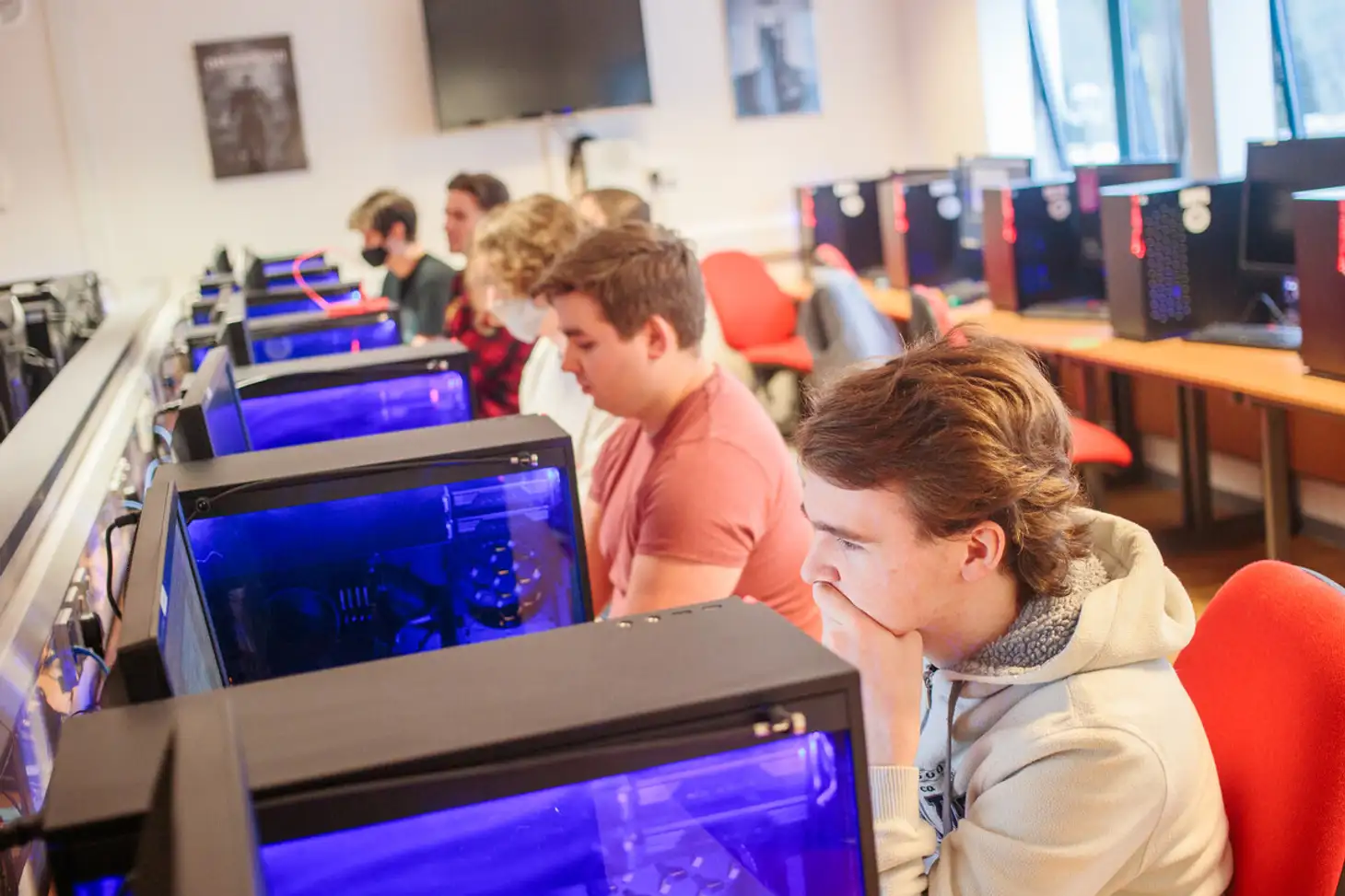
You will use modern computer labs equipped with the latest hardware and software throughout your course, supporting both practical classes and independent study. Alongside lecture theatres and classrooms, you’ll have access to a dedicated Internet of Things teaching space and a robotics lab, giving you hands-on experience with emerging technologies. You can also use the labs outside of taught sessions to practise your skills, complete assignments, and build confidence with industry-standard equipment.
From September 2026, our Computing, Engineering, Technology and Built Environment courses will move into their brand-new home: the Calon building.
This £60m investment will feature more than 40 new innovative teaching, learning and research spaces, including electronics and hydraulics labs, a flight simulator, a robotics lab, clean and industrial research spaces, collaborative teaching spaces, as well as virtual reality capability, and a range of exhibition spaces.
Calon will give you access to the technology, facilities and opportunities needed to shape the future.
Course Leader

Dr Paul Jarvis
Dr Paul Jarvis is a lecturer specialising in professional skills, information systems and IT Service Management, and is the Course Leader for BSc Computing. With a background in GIS research and expertise as a statistician and data analyst, Paul supports students throughout their studies, helping them build confidence, develop practical skills, and progress successfully on their course.
If you would like to learn more about our BSc Computing course and whether it suits your goals, you can email Paul directly.
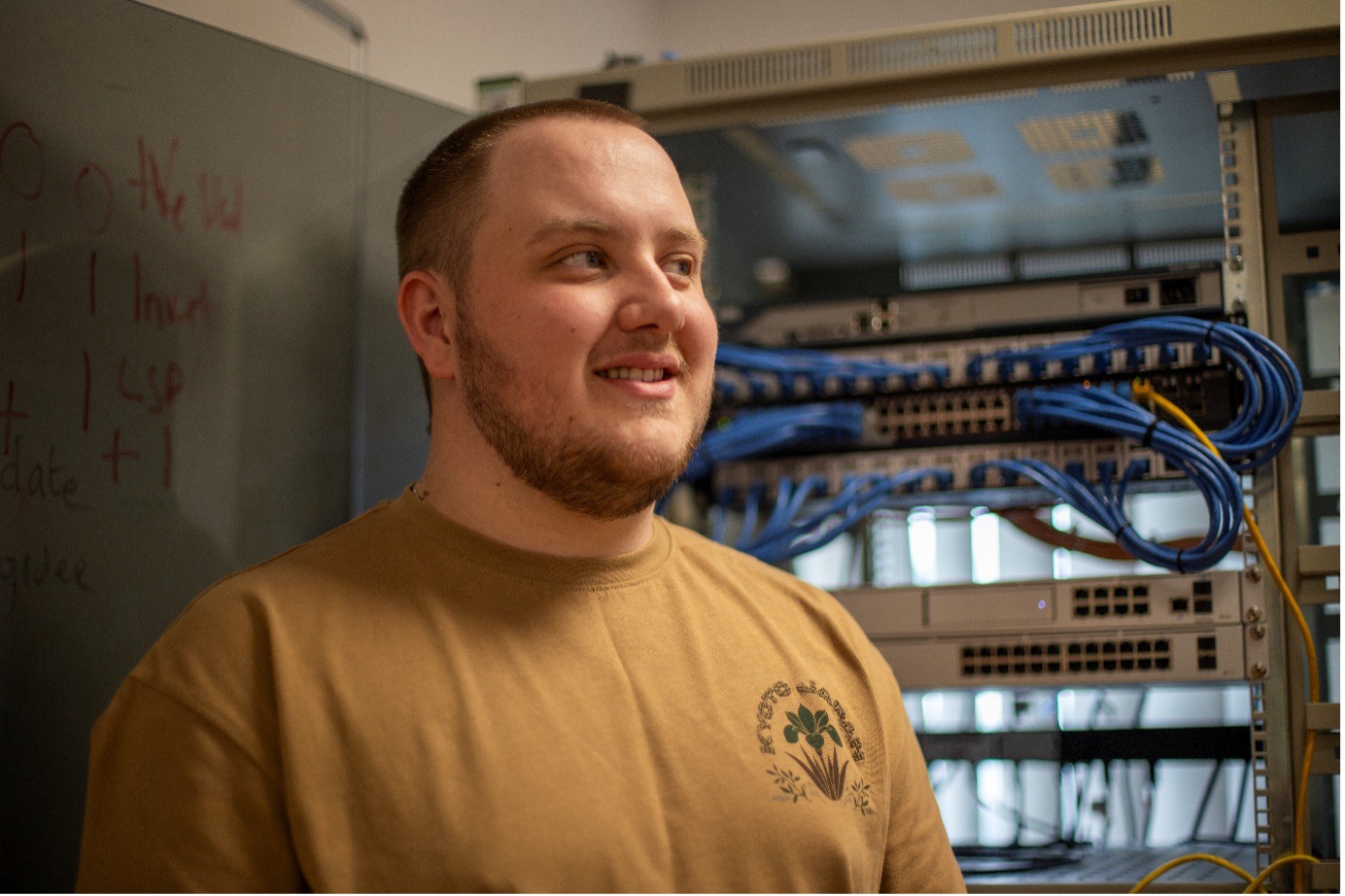
“In my first year I worked in IT for a windows and doors manufacturing company, and now I’m a software engineer in the civil service.”
Kieron Pritchard, Computing student
Entry Requirements
Additional
The University normally requires a minimum 5 GCSEs including Mathematics and English at Grade C or above, or their equivalent but consideration is given to individual circumstances.
Contextual offers
We may make you a lower offer based on a range of factors, including your background (where you live and the school or college that you attended, for example), your experiences and individual circumstances (as a care leaver, for example). This is referred to as a contextual offer, and we receive data from UCAS to support us in making these decisions.
USW prides itself on its student experience and we support our students to achieve their goals and become a successful graduate. This approach helps us to support students who have the potential to succeed and who may have faced barriers that make it more difficult to access university.
How to applyContextual admissions policyAsk us a question104 UCAS points or above
Typical qualification requirements
A Level:
BCC
Welsh BACC:
Advanced Skills Baccalaureate Wales Grade C in the Skills Challenge Certificate and BC at A Level
BTEC:
BTEC Extended Diploma Distinction Merit Merit
Access to HE:
Pass the Access to HE Diploma and obtain a minimum of 104 UCAS tariff points
T Level:
P
If you don’t reach the entry requirements at Year 1, this course also offers a Foundation Year alternative.
International applications welcomed:
We welcome international applications with equivalent qualifications of our entry requirements. For more details related to your country of residence, please view our dedicated country pages.
International studentsPre-Sessional EnglishEnglish language requirements
International applicants will need to have achieved an overall of IELTS 6.0 with a minimum of 5.5 in each component/TOEFL 4 overall and a minimum of 4 in each component or equivalent.
Equivalents can be located on our English Language pages.
If you have previously studied through the medium of English, IELTS might not be required, please visit our country specific page for further details. If your country is not featured, please contact us.
If you do not meet the English entry criteria, please visit our Pre-Sessional course pages.
Fees and Funding
Studying at university is one of the most significant investments you'll ever make. Whilst you’re studying, you’ll have two main financial obligations – tuition fees and living costs. There’s lots of financial help available from the University of South Wales and external funding sources, that may provide loans (which have to be paid back) and grants, scholarships and bursaries (that don't).
*Full-time fees are per year. Part-time fees are per 20 credits. Once enrolled, the fee is anticipated to remain at the same rate throughout the duration of your study on this course except as described below.
Please be aware that we may increase the maximum fee for home students on full-time undergraduate courses only where the Welsh Government increases the permitted level of inflation of fees. Fees for all students (including part-time, postgraduate and international students) may be amended in accordance with our applicable Fees and Debt Management Policy. We will ensure that students are given clear, intelligible, unambiguous and timely information about our courses and costs in good time, ahead of the next academic year.
As a student of USW, you’ll have access to lots of free resources to support your study and learning, such as textbooks, publications, online journals, laptops, and plenty of remote-access resources. Whilst in most cases these resources are more than sufficient in supporting you with completing your course, additional costs, both obligatory and optional, may be required or requested for the likes of travel, memberships, experience days, stationery, printing, or equipment.
per year
Studying at university is one of the most significant investments you'll ever make. Whilst you’re studying, you’ll have two main financial obligations – tuition fees and living costs. There’s lots of financial help available from the University of South Wales and external funding sources, that may provide loans (which have to be paid back) and grants, scholarships and bursaries (that don't).
*Full-time fees are per year. Part-time fees are per 20 credits. Once enrolled, the fee is anticipated to remain at the same rate throughout the duration of your study on this course except as described below.
Please be aware that we may increase the maximum fee for home students on full-time undergraduate courses only where the Welsh Government increases the permitted level of inflation of fees. Fees for all students (including part-time, postgraduate and international students) may be amended in accordance with our applicable Fees and Debt Management Policy. We will ensure that students are given clear, intelligible, unambiguous and timely information about our courses and costs in good time, ahead of the next academic year.
As a student of USW, you’ll have access to lots of free resources to support your study and learning, such as textbooks, publications, online journals, laptops, and plenty of remote-access resources. Whilst in most cases these resources are more than sufficient in supporting you with completing your course, additional costs, both obligatory and optional, may be required or requested for the likes of travel, memberships, experience days, stationery, printing, or equipment.

Explore our facilities


Work, earn and learn!
This course is also available through Network75, a combined work and study route.
Learn moreHow to apply
All applications for full-time undergraduate courses or foundation degrees should be made via UCAS. Take the next step: Apply through UCAS
You can apply to us directly for all part-time undergraduate courses, if you’re seeking advanced entry or you’re an international student. To apply directly, please choose the application form below for your preferred start date and mode of study (full-time or part-time).
-
Apply direct
Computing
-
Full-time, 3 years
-
September
-
Pontypridd
-
-
Apply direct
Computing
-
Sandwich, 4 years
-
September
-
Pontypridd
-
If you already have a relevant qualification or experience related to the course you're applying for, you may be eligible to start at a later stage of the course. For example, students from partner colleges can ‘top up’ their qualifications to a degree by joining us in Year Two or Year Three of a course. This process is known as ‘advanced entry’, you can apply directly to the University for 'advanced entry' using the application forms provided above.
Applicants accepted through advanced entry may study a different combination of modules to those advertised, as they will be joining a course already in progress. You will be contacted and advised about these modules once your application has been processed and an offer made.
International applicants can apply to us directly. If the University has an in-country team in your region, your application will be assigned to them for assistance.