Business and Management including Foundation Year
The Business Foundation Year introduces key business ideas while developing essential academic, personal and professional skills. Through practical learning and reflection, you’ll gain confidence and prepare to progress into degree-level study.
How to apply Apply through UCAS Book an Open Day Chat to us/filters:format(webp)/prod01/channel_2/media/university-of-south-wales/site-assets/images/16-other/business-services/business-services-business-generic.jpg)
UCAS Code
N10F
Start Date
September 2027
Location
Cardiff
Campus Code
B
UCAS Points
48
International students: £17,600*
Course Overview
You’ll learn through interactive tasks, collaborative projects and independent study, building skills in communication, problem-solving, teamwork and digital fluency.
Why study this course?
What you'll study
The Business Foundation Year builds academic confidence and core business understanding through practical learning, reflection and collaboration, preparing you to progress into degree-level business study with clarity, resilience and purpose.
For details of the modules you will study after successful completion of the Foundation Year, please see the main course page.
Develop academic, personal and professional skills for university study. You’ll reflect on your progress, build confidence, and create an evidence-based portfolio to support your future learning.
An introduction to how businesses work, covering key areas like marketing, finance and people. You’ll apply ideas to real scenarios while building confidence, teamwork, communication and study skills.
Explore how people think, feel and act at work. You’ll learn about teamwork, leadership and motivation, apply ideas to real challenges, and build academic and professional skills.
The Impact Challenge is a Foundation Year project module where students work in teams to tackle real-world issues, developing solutions through research, curiosity, teamwork, and responsible problem-solving.
We regularly review our courses to keep pace with changing skills and employer needs. If a review leads to significant changes, we’ll contact you to explain what’s changing for the coming year.
Teaching and Assessment
Teaching helps you understand how learning works at university, while building academic confidence, critical thinking and self-reflection.
You will learn through active, real-world learning experiences that encourage curiosity, collaboration and independent thinking. You’ll work independently and with others through discussions, practical activities and guided reflection, supported by digital tools. Regular feedback helps you recognise progress and plan next steps, supporting wellbeing, resilience and a strong sense of belonging as you prepare for a higher level of study.
You’ll be assessed in different ways, including short tasks, coursework, presentations, and group work. Early assessments are designed to support your learning and help you understand what is expected at university. Most assessments are coursework-based and help you develop key skills such as research, academic writing, teamwork, and communication. You’ll also reflect on your progress and use university systems and digital tools.
Our Business and Management degree actively encourages internships so, if you choose to take a sandwich year during your degree, we’ll support you with applications to help you get your foot in the door. Our team will keep an eye on you during your placement, speaking with your employer and visiting your place of work.
Course Leader
Emma Wheeler
Emma Wheeler is the Course Leader for the Foundation Year. Emma has many years of teaching experience, working with students who have been out of education for some time. Classroom environments on the Foundation Year are sensitive, encouraging and responsive to a wide range of needs from our students and help you go on to the degree course with confidence.
For details of the Course Leader on the degree course please visit the course page.
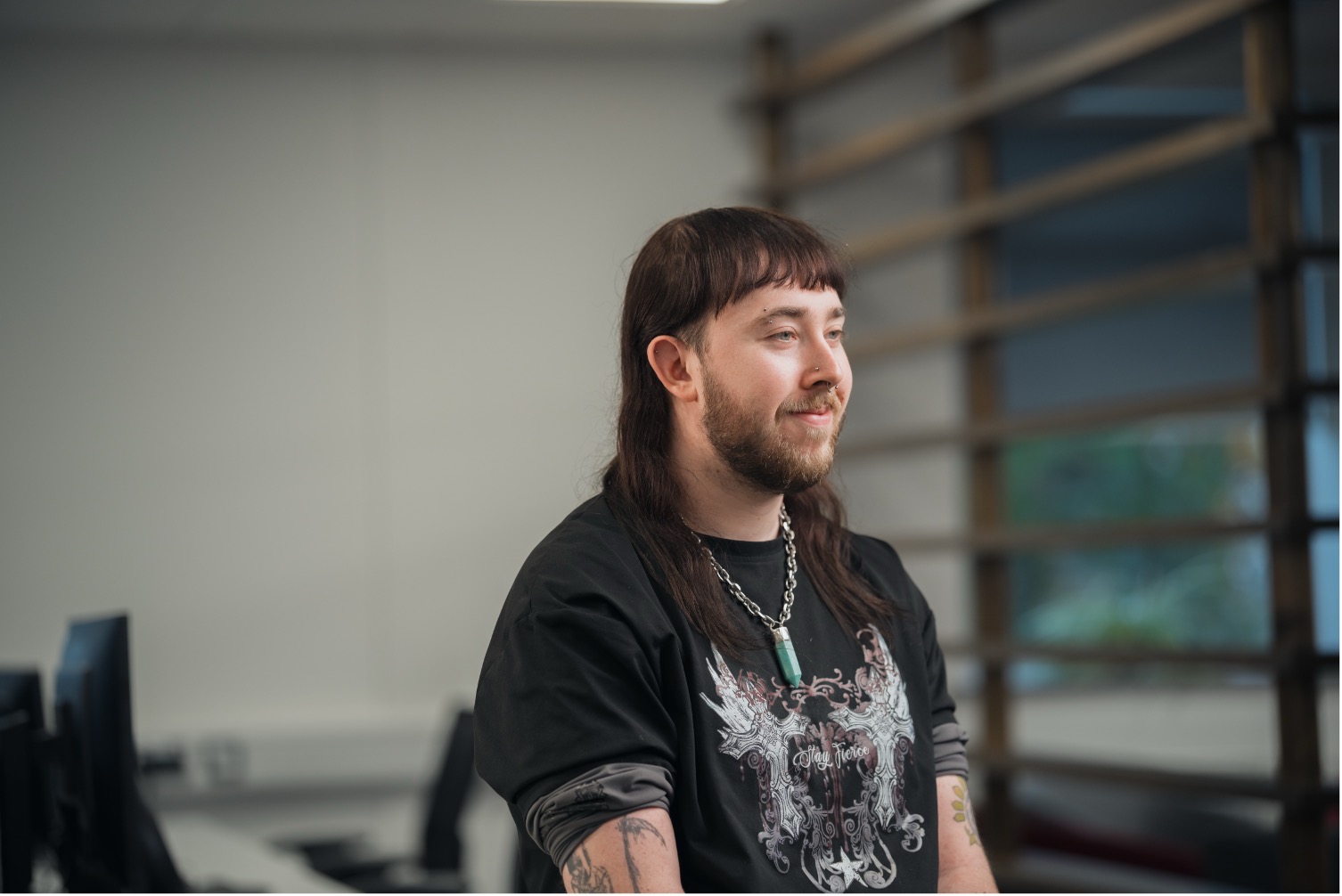
"I learned how to speak in front of people and step outside my comfort zone."
Tito, Foundation Year student
Entry Requirements
Contextual offers
We may make you a lower offer based on a range of factors, including your background (where you live and the school or college that you attended, for example), your experiences and individual circumstances (as a care leaver, for example). This is referred to as a contextual offer, and we receive data from UCAS to support us in making these decisions.
USW prides itself on its student experience and we support our students to achieve their goals and become a successful graduate. This approach helps us to support students who have the potential to succeed and who may have faced barriers that make it more difficult to access university.
How to applyContextual admissions policyAsk us a question48 UCAS points or above
Typical qualification requirements:
A Level:
DD
BTEC:
BTEC Extended Diploma Pass Pass Pass or BTEC Diploma Pass Pass
Access to HE:
Pass the Access to HE Diploma with a minimum of 48 UCAS Tariff points
T Level:
Pass (D or E)
Additional requirements:
The University normally requires a minimum 3 GCSEs at Grade C or above, including Mathematics (Numeracy AND Mathematics in Wales) and English Language. For those taking GCSEs in England, a Grade 4 is considered equivalent to a C.
International applications welcomed:
We welcome international applications with equivalent qualifications of our entry requirements. For more details related to your country of residence, please view our dedicated country pages.
International studentsPre-Sessional EnglishEnglish language requirements
International applicants will need to have achieved an overall of IELTS 6.0 with a minimum of 5.5 in each component/TOEFL 4 overall and a minimum of 4 in each component or equivalent.
Equivalents can be located on our English Language pages.
If you have previously studied through the medium of English, IELTS might not be required, please visit our country specific page for further details. If your country is not featured, please contact us.
If you do not meet the English entry criteria, please visit our Pre-Sessional course pages.
Fees and Funding
Studying at university is one of the most significant investments you'll ever make. Whilst you’re studying, you’ll have two main financial obligations – tuition fees and living costs. There’s lots of financial help available from the University of South Wales and external funding sources, that may provide loans (which have to be paid back) and grants, scholarships and bursaries (that don't).
Foundation Year Tuition Fee
Where applicable, the Tuition Fee for international students is as listed in the fees section above. Please be advised that the fee shown is for the Foundation Year only. Subsequent years will be charged at the standard undergraduate tuition fee rate applicable to the relevant academic year.
Further Information
Please be aware that we may increase the maximum fee for home students on full-time undergraduate courses only where the Welsh Government increases the permitted level of inflation of fees. Fees for all students (including part-time, postgraduate and international students) may be amended in accordance with our applicable Fees and Debt Management Policy. We will ensure that students are given clear, intelligible, unambiguous and timely information about our courses and costs in good time, ahead of the next academic year.
As a student of USW, you’ll have access to lots of free resources to support your study and learning, such as textbooks, publications, online journals, laptops, and plenty of remote-access resources. Whilst in most cases these resources are more than sufficient in supporting you with completing your course, additional costs, both obligatory and optional, may be required or requested for the likes of travel, memberships, experience days, stationery, printing, or equipment.
Internship
Students are offered the opportunity to complete an internship during their second year of study. Students undertaking an internship may incur costs associated with travel and expected workplace attire and this will vary according to the placement.
Cost: Up to £300
Textbooks
Textbooks are provided via the USW library but students may wish to purchase their own private copies. This cost is optional.
Cost: Up to £300
Laptop
The University has computers available on campus and laptops for loan. However, it is highly recommended that you have your own personal laptop, which will be capable of running Microsoft Office 365. As a student you will be able to download a free copy of any software relevant to the course.
Cost: £250
Professional Body Registration
Optional professional body registration fees.
Cost: Up to £210
per year
Studying at university is one of the most significant investments you'll ever make. Whilst you’re studying, you’ll have two main financial obligations – tuition fees and living costs. There’s lots of financial help available from the University of South Wales and external funding sources, that may provide loans (which have to be paid back) and grants, scholarships and bursaries (that don't).
Foundation Year Tuition Fee
Where applicable, the Tuition Fee for international students is as listed in the fees section above. Please be advised that the fee shown is for the Foundation Year only. Subsequent years will be charged at the standard undergraduate tuition fee rate applicable to the relevant academic year.
Further Information
Please be aware that we may increase the maximum fee for home students on full-time undergraduate courses only where the Welsh Government increases the permitted level of inflation of fees. Fees for all students (including part-time, postgraduate and international students) may be amended in accordance with our applicable Fees and Debt Management Policy. We will ensure that students are given clear, intelligible, unambiguous and timely information about our courses and costs in good time, ahead of the next academic year.
As a student of USW, you’ll have access to lots of free resources to support your study and learning, such as textbooks, publications, online journals, laptops, and plenty of remote-access resources. Whilst in most cases these resources are more than sufficient in supporting you with completing your course, additional costs, both obligatory and optional, may be required or requested for the likes of travel, memberships, experience days, stationery, printing, or equipment.
Internship
Students are offered the opportunity to complete an internship during their second year of study. Students undertaking an internship may incur costs associated with travel and expected workplace attire and this will vary according to the placement.
Cost: Up to £300
Textbooks
Textbooks are provided via the USW library but students may wish to purchase their own private copies. This cost is optional.
Cost: Up to £300
Laptop
The University has computers available on campus and laptops for loan. However, it is highly recommended that you have your own personal laptop, which will be capable of running Microsoft Office 365. As a student you will be able to download a free copy of any software relevant to the course.
Cost: £250
Professional Body Registration
Optional professional body registration fees.
Cost: Up to £210
/filters:format(webp)/prod01/channel_2/media/university-of-south-wales/site-assets/images/18-campaign-assets/built-to-shape-futures/campaign-built-to-shape-futures-58868.jpg)
/filters:format(webp)/prod01/channel_2/media/university-of-south-wales/site-assets/images/01-campus-and-facilities/12-campus-spaces/campus-spaces-cardiff-library-pod.jpg)
How to apply
All applications for full-time undergraduate courses or foundation degrees should be made via UCAS. Take the next step: Apply through UCAS
You can apply to us directly for all part-time undergraduate courses, if you’re seeking advanced entry or you’re an international student. To apply directly, please choose the application form below for your preferred start date and mode of study (full-time or part-time).
-
Apply direct
Business and Management including Foundation Year
-
Full-time, 4 years
-
September
-
Cardiff
-
If you already have a relevant qualification or experience related to the course you're applying for, you may be eligible to start at a later stage of the course. For example, students from partner colleges can ‘top up’ their qualifications to a degree by joining us in Year Two or Year Three of a course. This process is known as ‘advanced entry’, you can apply directly to the University for 'advanced entry' using the application forms provided above.
Applicants accepted through advanced entry may study a different combination of modules to those advertised, as they will be joining a course already in progress. You will be contacted and advised about these modules once your application has been processed and an offer made.
International applicants can apply to us directly. If the University has an in-country team in your region, your application will be assigned to them for assistance.
/filters:format(webp)/prod01/channel_2/media/university-of-south-wales/site-assets/images/04-profiles/41-undergraduate-student/profile-ug-business-and-management-Sumaya-Khan-49799.jpg)
/filters:format(webp)/prod01/channel_2/media/university-of-south-wales/site-assets/images/04-profiles/41-undergraduate-student/profile-foundation-year-tito.jpg)
/filters:format(webp)/prod01/channel_2/media/university-of-south-wales/site-assets/images/04-profiles/41-undergraduate-student/profile-business-jasmine-brough-753X1006.jpg)
/filters:format(webp)/prod01/channel_2/media/university-of-south-wales/site-assets/images/04-profiles/41-undergraduate-student/profile-business-cameron-jones-1.jpg)
/filters:format(webp)/prod01/channel_2/media/university-of-south-wales/site-assets/images/04-profiles/41-undergraduate-student/profile-business-mahbubul-alom-915X1006.jpg)
Related stories and highlights
/filters:format(webp)/prod01/channel_2/media/university-of-south-wales/site-assets/images/news/2026/04-april/AI-in-Business-GettyImages-2200550660.jpg)
/filters:format(webp)/prod01/channel_2/media/university-of-south-wales/site-assets/images/news/2024/11-november/Lyndsey-Crompton.jpg)
/filters:format(webp)/prod01/channel_2/media/university-of-south-wales/site-assets/images/news/2026/02-february/Grand-Challenge-winners.jpg)
/filters:format(webp)/prod01/channel_2/media/university-of-south-wales/site-assets/images/news/2026/10-october/Young-Enterprise-students.jpg)
/filters:format(webp)/prod01/channel_2/media/university-of-south-wales/site-assets/images/news/2026/05-may/Women-in-Leadership-GettyImages-1063611604.jpg)
/filters:format(webp)/prod01/channel_2/media/university-of-south-wales/site-assets/images/07-student-life/72-students-union/student-life-students-union--52621.jpg)