Professional Policing including Foundation Year
Build the academic skills and knowledge needed to progress into professional policing.
How to apply Register for open day Chat to us/filters:format(webp)/prod01/channel_2/media/university-of-south-wales/site-assets/images/03-courses/policing-and-security/bsc-professional-policing-including-foundation-year.jpg)
UCAS Code
PP1F
Start Date
September 2026
Location
Pontypridd
Campus Code
A
UCAS Points
48
Fees
Home students: £5,760*
International students: £17,200*
UCAS Code
PP1F
Start Date
September 2027
Location
Pontypridd
Campus Code
A
UCAS Points
48
International students: £17,600*
Course Overview
This foundation year supports your transition into higher education while introducing key policing and public service themes.
If you don't have the right qualifications to apply for the BSc (Hons) Professional Policing degree year one entry, the foundation course offers an alternative route into degree study.
Why study this course?
What you'll study
Prepare for university study by developing core academic skills while exploring policing and wider public service issues.
Through teamwork, reflection and applied learning, you’ll build confidence and understanding across the foundation year. For details of the modules you will study after successful completion of the Foundation Year, please see the main course page.
Develop academic, personal and professional skills for university study. You’ll reflect on your progress, build confidence, and create an evidence-based portfolio to support your future learning.
Focusing on crime and justice in society, this module examines how media, identity and public opinion shape understanding and policy. You’ll engage with key debates and propose evidence-informed reforms.
An introduction to criminal investigations in England and Wales, exploring investigative processes, ethical decision-making and professional practice. You’ll apply investigative thinking to realistic scenarios across different types of crime.
The Impact Challenge is a Foundation Year project module where students work in teams to tackle real-world issues, developing solutions through research, curiosity, teamwork, and responsible problem-solving.
We regularly review our courses to keep pace with changing skills and employer needs. If a review leads to significant changes, we’ll contact you to explain what’s changing for the coming year.
Teaching and Assessment
You will learn through active, real-world learning experiences that encourage curiosity, collaboration and independent thinking.
Teaching helps you understand how learning works at university, while building academic confidence, critical thinking and self-reflection. You’ll work independently and with others through discussions, practical activities and guided reflection, supported by digital tools. Regular feedback helps you recognise progress and plan next steps, supporting wellbeing, resilience and a strong sense of belonging as you prepare for a higher level of study.
You’ll be assessed in different ways, including short tasks, coursework, presentations, and group work. Early assessments are designed to support your learning and help you understand what is expected at university. Most assessments are coursework-based and help you develop key skills such as research, academic writing, teamwork, and communication. You’ll also reflect on your progress and use university systems and digital tools. Clear, timely feedback will help you understand how to improve and support your next steps.
If you want to volunteer as a Special Constable or police student volunteer, we will help you prepare for that role and will be happy to support your application.
Our Hydra Simulation Centre - the only one in Wales - helps you practise dealing with realistic scenarios such as major crime enquiries. The simulation suite allows you to experience these incidents in a safe learning environment.
The Crime Scene Training Facility is where you practise your crime scene investigation techniques. We have forensic facilities where you can explore and analyse forensic evidence, and interview rooms with CCTV systems so you can observe and assess your interview skills.
Our state-of-the-art moot court room provides an immersive environment for debates, press conferences with our journalism students and mock trials.
Course Leader
Emma Wheeler
Emma Wheeler is the Course Leader for the Foundation Year. Emma has many years of teaching experience, working with students who have been out of education for some time. Classroom environments on the Foundation Year are sensitive, encouraging and responsive to a wide range of needs from our students and help you go on to the degree course with confidence.
For details of the Course Leader on the degree course please visit the course page.
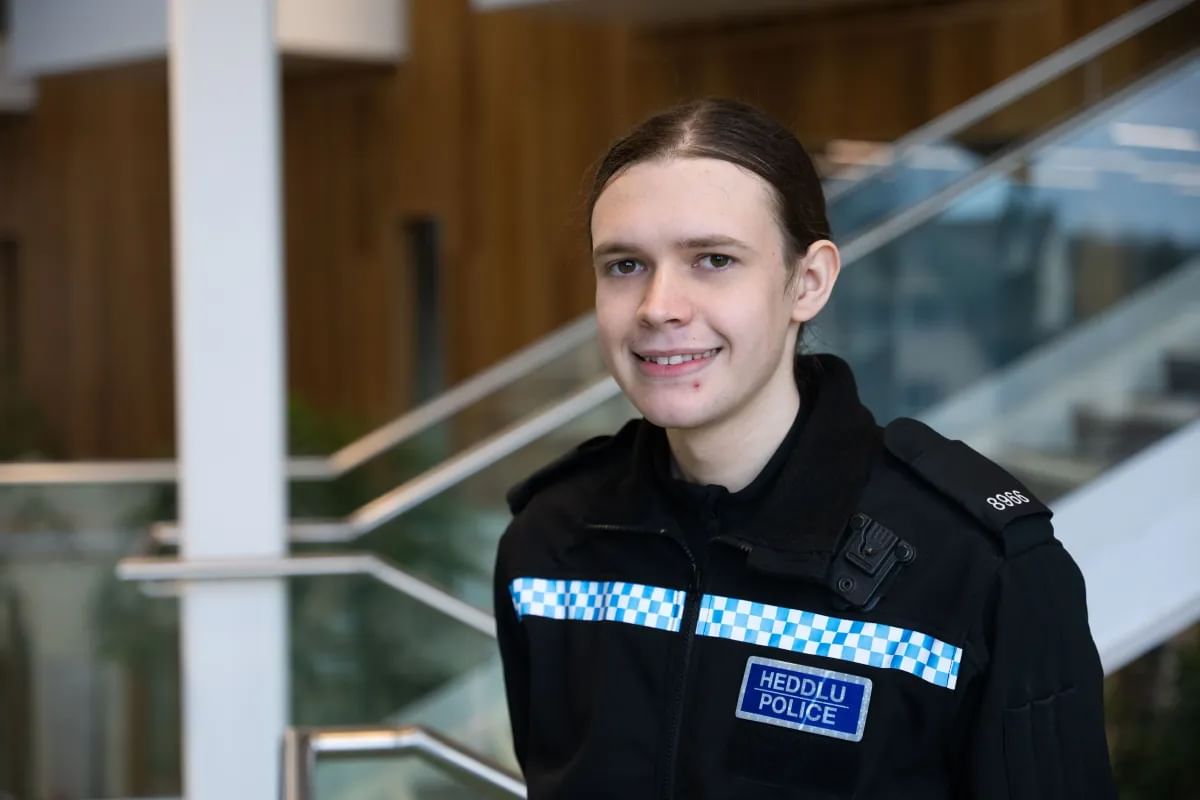
"You finish the degree and then a couple months later you’re walking through the doors to be a police officer."
Layla, Professional Policing Student
Entry Requirements
Contextual offers
We may make you a lower offer based on a range of factors, including your background (where you live and the school or college that you attended, for example), your experiences and individual circumstances (as a care leaver, for example). This is referred to as a contextual offer, and we receive data from UCAS to support us in making these decisions.
USW prides itself on its student experience and we support our students to achieve their goals and become a successful graduate. This approach helps us to support students who have the potential to succeed and who may have faced barriers that make it more difficult to access university.
How to applyContextual admissions policyAsk us a question48 UCAS points or above
Typical qualification requirements:
A Level:
DD to exclude General Studies.
BTEC:
BTEC Extended Diploma Pass Pass Pass or BTEC Diploma Pass Pass.
Access to HE:
Pass the Access to HE Diploma with a minimum of 48 UCAS Tariff points.
Additional Requirements:
The University normally requires a minimum 3 GCSEs including Mathematics and English at Grade C or above, or their equivalent but consideration is given to individual circumstances
Please note that whilst this course does not require a DBS Check for entry, some professions will not consider candidates who have certain types of criminal convictions. Therefore, if you have a criminal conviction and you are considering a particular career path we would recommend that you check with the relevant professional body or refer to their recruitment policy to make sure that your conviction will not disadvantage you.
International applications welcomed:
We welcome international applications with equivalent qualifications of our entry requirements. For more details related to your country of residence, please view our dedicated country pages.
International studentsPre-Sessional EnglishEnglish language requirements
International applicants will need to have achieved an overall of IELTS 6.0 with a minimum of 5.5 in each component/TOEFL 4 overall and a minimum of 4 in each component or equivalent.
Equivalents can be located on our English Language pages.
If you have previously studied through the medium of English, IELTS might not be required, please visit our country specific page for further details. If your country is not featured, please contact us.
If you do not meet the English entry criteria, please visit our Pre-Sessional course pages.
Fees and Funding
per year
Studying at university is one of the most significant investments you'll ever make. Whilst you’re studying, you’ll have two main financial obligations – tuition fees and living costs. There’s lots of financial help available from the University of South Wales and external funding sources, that may provide loans (which have to be paid back) and grants, scholarships and bursaries (that don't).
Foundation Year Tuition Fee
Where applicable, the Tuition Fee for international students is as listed in the fees section above. Please be advised that the fee shown is for the Foundation Year only. Subsequent years will be charged at the standard undergraduate tuition fee rate applicable to the relevant academic year.
Further Information
Please be aware that we may increase the maximum fee for home students on full-time undergraduate courses only where the Welsh Government increases the permitted level of inflation of fees. Fees for all students (including part-time, postgraduate and international students) may be amended in accordance with our applicable Fees and Debt Management Policy. We will ensure that students are given clear, intelligible, unambiguous and timely information about our courses and costs in good time, ahead of the next academic year.
As a student of USW, you’ll have access to lots of free resources to support your study and learning, such as textbooks, publications, online journals, laptops, and plenty of remote-access resources. Whilst in most cases these resources are more than sufficient in supporting you with completing your course, additional costs, both obligatory and optional, may be required or requested for the likes of travel, memberships, experience days, stationery, printing, or equipment.
Placement expenses
The exact cost of attending any placement is dependent upon the its location in relation to the student's place of residence, mode of transportation etc. and therefore cannot be determined at this moment in time. Furthermore, depending upon the placement the student may need to purchase suitable attire (e.g. a suit or formal clothing).
Cost: Up to £300
Additional assessment or memberships: Student membership of professional bodies
Reduced fee membership of ACCA "Accelerate" scheme. Normally £79 but we have a special fee of £20.
Cost: £20
Other: Text books
Some additional text books may need to be purchased.
Cost: £300
Other: Travel costs for work placements
Placement Year. Travel costs depend on placement location.
Cost: Up to £300
per year
Studying at university is one of the most significant investments you'll ever make. Whilst you’re studying, you’ll have two main financial obligations – tuition fees and living costs. There’s lots of financial help available from the University of South Wales and external funding sources, that may provide loans (which have to be paid back) and grants, scholarships and bursaries (that don't).
Foundation Year Tuition Fee
Where applicable, the Tuition Fee for international students is as listed in the fees section above. Please be advised that the fee shown is for the Foundation Year only. Subsequent years will be charged at the standard undergraduate tuition fee rate applicable to the relevant academic year.
Further Information
Please be aware that we may increase the maximum fee for home students on full-time undergraduate courses only where the Welsh Government increases the permitted level of inflation of fees. Fees for all students (including part-time, postgraduate and international students) may be amended in accordance with our applicable Fees and Debt Management Policy. We will ensure that students are given clear, intelligible, unambiguous and timely information about our courses and costs in good time, ahead of the next academic year.
As a student of USW, you’ll have access to lots of free resources to support your study and learning, such as textbooks, publications, online journals, laptops, and plenty of remote-access resources. Whilst in most cases these resources are more than sufficient in supporting you with completing your course, additional costs, both obligatory and optional, may be required or requested for the likes of travel, memberships, experience days, stationery, printing, or equipment.
Placement expenses
The exact cost of attending any placement is dependent upon the its location in relation to the student's place of residence, mode of transportation etc. and therefore cannot be determined at this moment in time. Furthermore, depending upon the placement the student may need to purchase suitable attire (e.g. a suit or formal clothing).
Cost: Up to £300
Additional assessment or memberships: Student membership of professional bodies
Reduced fee membership of ACCA "Accelerate" scheme. Normally £79 but we have a special fee of £20.
Cost: £20
Other: Text books
Some additional text books may need to be purchased.
Cost: £300
Other: Travel costs for work placements
Placement Year. Travel costs depend on placement location.
Cost: Up to £300
/filters:format(webp)/prod01/channel_2/media/university-of-south-wales/site-assets/images/18-campaign-assets/built-to-shape-futures/campaign-built-to-shape-futures-58868.jpg)
/filters:format(webp)/prod01/channel_2/media/university-of-south-wales/site-assets/images/01-campus-and-facilities/12-campus-spaces/campus-spaces-cardiff-library-pod.jpg)
How to apply
All applications for full-time undergraduate courses or foundation degrees should be made via UCAS. Take the next step: Apply through UCAS
You can apply to us directly for all part-time undergraduate courses, if you’re seeking advanced entry or you’re an international student. To apply directly, please choose the application form below for your preferred start date and mode of study (full-time or part-time).
-
Apply direct
Professional Policing including Foundation Year
-
Full-time, 4 years
-
September
-
Pontypridd
-
-
Apply direct
Professional Policing including Foundation Year
-
Full-time, 4 years
-
September
-
Pontypridd
-
If you already have a relevant qualification or experience related to the course you're applying for, you may be eligible to start at a later stage of the course. For example, students from partner colleges can ‘top up’ their qualifications to a degree by joining us in Year Two or Year Three of a course. This process is known as ‘advanced entry’, you can apply directly to the University for 'advanced entry' using the application forms provided above.
Applicants accepted through advanced entry may study a different combination of modules to those advertised, as they will be joining a course already in progress. You will be contacted and advised about these modules once your application has been processed and an offer made.
International applicants can apply to us directly. If the University has an in-country team in your region, your application will be assigned to them for assistance.
/filters:format(webp)/prod01/channel_2/media/university-of-south-wales/site-assets/images/04-profiles/44-alumni/profile-alumni-policing-saffron-57430.jpg)
/filters:format(webp)/prod01/channel_2/media/university-of-south-wales/site-assets/images/04-profiles/44-alumni/profile-alumni-policing-andre-57449.jpg)
/filters:format(webp)/prod01/channel_2/media/university-of-south-wales/site-assets/images/04-profiles/44-alumni/profile-alumni-policing-layla-57441.jpg)
/filters:format(webp)/prod01/channel_2/media/university-of-south-wales/site-assets/images/08-subjects/policing-and-security/bsc-professional-policing-accelerated.jpg)
/filters:format(webp)/prod01/channel_2/media/university-of-south-wales/site-assets/images/16-other/about-us/our-strategy/about-us-our-strategy-crime-security-and-justice-accelerator.jpg)
/filters:format(webp)/prod01/channel_2/media/university-of-south-wales/site-assets/images/07-student-life/72-students-union/student-life-students-union--52621.jpg)